
On Thursday, 5th March, specialist marketplace recruiter, Patrick Murray, brought together a leading panel to discuss how artificial intelligence (AI) is being implemented across the sector. This article recounts the key takeaways from the conversation with insights from:
- Stephen Honight, Founder at The Lmo7 Agency
- Claire Leon, Co-Founder at Acorn-i
- Max Sinclair, Founder and CEO at Azoma
- Scott Bowerman, Senior Partnerships Manager at Xnurta
Together, they discussed:
- The impact of AI on ecommerce
- Amazon and Walmart's AI agents
- How to prepare your brand for the new age of online shopping
- The importance of moving quickly
How is AI reshaping online shopping?
For years, digital commerce has been built on a relatively simple model: search → browse → compare → purchase.
Whether on Google or Amazon, the process has remained largely the same. Consumers input a keyword, scan a list of results, and make a decision based on what they see. Now that model is being quietly disrupted.
The way we discover and buy is changing
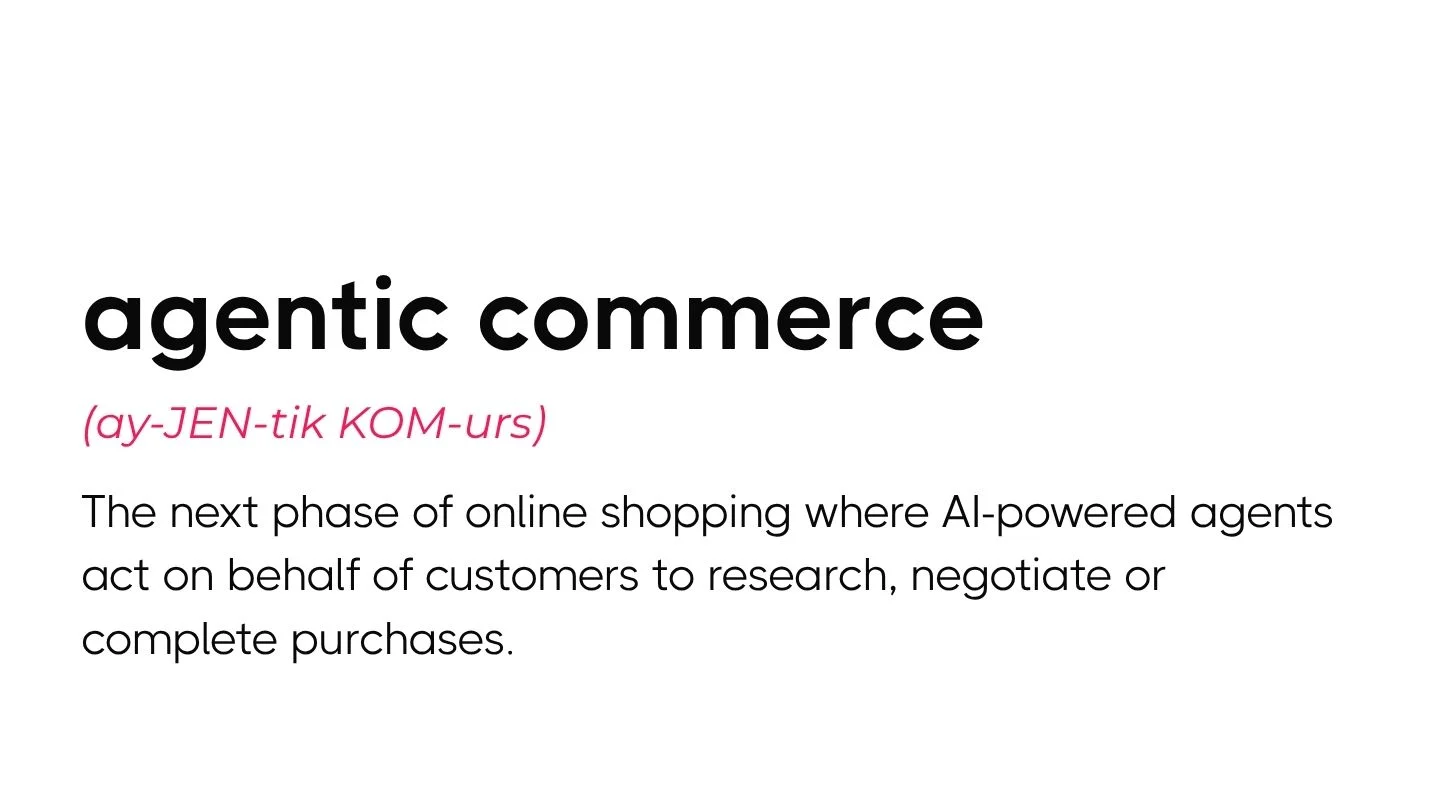
We are entering a new era of “agentic commerce”, where consumers are no longer just searching, but asking, refining, and increasingly delegating decisions to AI. As one speaker said, for retail brands this means that “Rather than optimising for keywords now, we're optimising for the world knowledge of an LLM.”
What is agentic commerce?
Instead of typing ‘best running shoes’, a user might ask, “What are the best running shoes for marathon training with knee support under £150?” Instead of receiving a list of links, they receive a personalised shopping experience:
- A curated answer
- A shortlist of recommendations
- User-generated reviews
- In some cases, a direct path to purchase
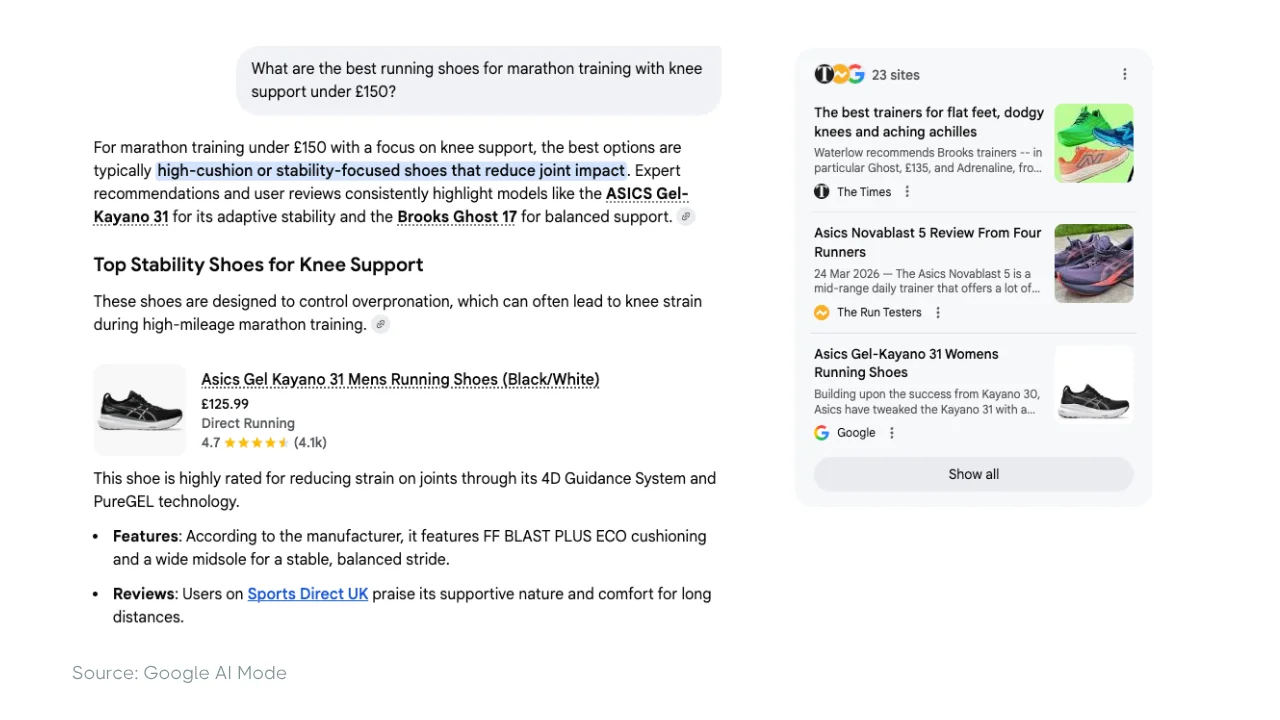
This shift dramatically changes how customers discover products. Where traditional retail offered near-infinite choices, AI in retail has now compressed searches from hundreds of products on a shelf to dozens on a search results page to just a handful (or sometimes even a single recommendation).
The latter is the future. As one speaker shared, “In the future we're just buying what the AI agent tells us based on all of the data and everything else it's compressing.” What this means for retail companies is that the battle is no longer about being one of many options – it’s about being the option.
The race to own the customer journey
At the same time, a second shift is happening. The platforms that power these AI-enabled experiences aren’t just trying to improve search; they are competing to own the entire customer journey. For example:
- ChatGPT and Gemini are moving towards enabling users to discover and buy without ever leaving the platform
- Amazon, through tools like Rufus, is doubling down on keeping users within its own ecosystem
- Retailers like Walmart and Shopify are rapidly integrating AI into their own experiences to stay competitive
Why are AI solutions a priority for ecommerce platforms?
Brands are racing for control when it comes to AI in online shopping, as whoever owns the interface – the place where the question is asked – ultimately controls:
- What products are seen
- Which brands are recommended
- Where the transaction happens
- Crucially, who owns the customer data
In the past, brands focused heavily on optimising for the point of conversion (the product page, the ad, the listing). Now, the real influence is shifting further upstream.
The most important question is no longer “Where do we convert?”, it’s “Where does the journey begin?”
Amazon Rufus and the rise of the decision engine
While much of the conversation around artificial intelligence in ecommerce focuses on ChatGPT and Google, one of the most important developments is happening much closer to the point of purchase.
Amazon is leading the development of integrated AI shopping assistants, with the development of Rufus.
Unlike traditional search on Amazon – where users type in keywords and scroll through listings – Rufus is designed to guide decisions in real time. Rufus allows users to:
- Ask detailed product questions
- Compare options instantly
- Receive personalised recommendations
- Understand features, use cases, and trade-offs
This is the shift from search engines to decision engines.
The impact of decision engines
This shift is already having an immense impact on the way customers shop. According to Amazon, “Customers who use [Rufus] while shopping are over 60% more likely to make a purchase during that shopping trip.”
This isn’t a small improvement; it’s a clear evolution in how users interact with the platform.
Plus, as retail AI continues to grow, Rufus is quickly evolving. In the US, it already includes:
- Hyper-personalisation based on browsing and purchase behaviour
- Visual search and product comparisons
- Price tracking and alerts
- The ability to browse beyond Amazon itself
As one speaker put it, “Rufus, in my mind, is the most advanced AI shopping agent today.”
Amazon isn’t alone in this direction, however, as Walmart’s equivalent, Sparky, is showing similar trends:
- Significant user adoption
- Larger basket sizes
- Increased engagement
In fact, Walmart reports that customers using Spakry place a 35% larger order than those who do not.
From browsing to guided buying
These tools are reshaping shopping behaviour. Traditionally, shopping online has been exploratory, comparison-led and often time-consuming. AI assistants remove much of that friction. They interpret intent instantly, narrow down options and provide confidence in decision-making. In doing so, they accelerate the journey from consideration to conversion.
According to our speakers, the rise of these decision engines will play a bigger long-term shift. Search as we know it is being replaced by conversation, recommendation, and automation.
What this means for brands
For brands selling on platforms like Amazon, this introduces a new reality. You are no longer competing for page-one visibility, but competing to be recommended by the system itself.
Recommendations are based on:
- Product data quality
- Content clarity
- Customer interactions and reviews
- Relevance to specific use cases
- Performance signals that AI can interpret
The challenge becomes less about driving traffic, and more about earning trust from the algorithm.
How to prepare your ecommerce business for AI systems
With discovery changing, brands must change how they show up. AI search engines, Amazon’s Rufus and Walmart’s Sparky all demand a different approach to optimisation. To be successful on each, brands must reconsider:
- The content on their individual product listings
- How the brand shows up across the web
- Their AI roadmap
Optimising your product listings
For the past decade, marketplace and search engine optimisation has largely been built around one principle: keywords. But in an AI-driven world, that approach is quickly becoming outdated.
Natural language processing (NLP) has changed the way customers that search. Consumers are no longer searching in fragments. Now, they’re asking detailed, contextual questions and AI doesn’t just match those queries to keywords, it interprets them.
These systems:
- Break queries into multiple ‘tokens’
- Run several parallel searches
- Apply the data they have gathered on the user (‘world knowledge’) to understand intent
This fundamentally changes how companies optimise their business and product listings for search. Brands need to move away from:
- Stuffing listings with variations of the same keyword
- Chasing low-competition search terms
And towards:
- Clearly explaining what your product is
- Demonstrating how it’s used
- Answering the real questions customers are asking
In simple terms, we’re moving from keyword optimisation to comprehension optimisation.
From rankings to recommendations
Alongside the shift in content creation, brands must adapt their thinking around what ‘good’ looks like.
In traditional search, success meant ranking on page one, but in AI-driven discovery, there is no page one. Instead, AI systems:
- Run multiple queries behind the scenes
- Pull from a wide range of sources
- Synthesize those inputs into a single answer
This creates a completely new dynamic, as your brand doesn’t just need to rank, it needs to be referenced. Visibility is now more heavily influenced by:
- Your own website content
- Third-party articles and reviews
- Affiliate sites
- Customer sentiment and ratings
- Broader presence across the web, such as social media
For Answer Engine Optimisation (AEO), it is no longer enough to optimise a product page in isolation or focus purely on one platform (e.g. Amazon or Google). Instead, brands need to think about their entire digital footprint.
There are opportunities everywhere. As one speaker shared, “You can write a good blog on your brand.com, and that will be fed into Sparky. You can basically influence Sparky via your own website.”
Because AI is effectively asking, “Which sources can I trust to answer this question?”, and then building its recommendation from there.
The window for organic advantage is closing
Retail brands must move quickly in order to capitalise on this changing landscape. While we are still in the early stages of AI-driven discovery, the window for opportunity is closing.
Right now, much of the visibility within AI platforms is still organic. Recommendations are largely driven by:
- Content quality
- Relevance
- Presence across trusted sources
- Product data and performance signals
But this won’t last. As highlighted during the panel, “The window for organic optimisation in these models is right now. As ads come in, it will be easier to pay to get that top position.”
We’ve seen this pattern before.
- Early Google → organic SEO advantage
- Early Amazon → organic ranking dominance
- Social platforms → early reach before paid saturation
AI is following the same trajectory, and the signs of change are already there:
- Sponsored prompts are emerging within Amazon Rufus
- Ads are being introduced into ChatGPT experiences
- Retail media networks are evolving to integrate AI-led placements
What is currently a content and optimisation challenge will quickly become a paid ads investment challenge.
Change is happening faster
The difference between AI evolution and other ecommerce changes is speed. AI adoption is accelerating far faster than previous platform shifts and with that, the window to build an organic advantage is significantly shorter. Brands that move early have the chance to:
- Shape how AI systems interpret their products
- Build presence across the sources AI trusts
- Establish authority before competition intensifies
Once paid placements become the primary route to visibility, the dynamics change again.
How should brands react
The next 12–18 months represent a critical phase to:
- Invest in content that answers real customer questions
- Build presence across trusted third-party sources
- Understand how AI platforms are currently surfacing and recommending products
- Test and learn quickly, while the cost of experimentation is still relatively low
Once the ecosystem matures, the barrier to entry rises. By that point, the brands that are already embedded in AI recommendations will be significantly harder to displace.
Is your ecommerce and marketplace team prepared?
If your business is going to succeed on each of these artificial intelligence platforms, you need the right talent in place. For specialist ecommerce and marketplace recruitment support, partner with our consultants. Leveraging our unique Advise, Attract, Develop approach, we’ll ensure you engage the right hires for the future of ecommerce.