

With almost 2 million feed updates viewed every minute, LinkedIn is first and foremost a social media platform. However, there’s another side to the website that not many get to see. LinkedIn Recruiter is the reason why so many users find their next role on the site.
At our recent Personal Branding breakfast event, our specialist real estate and professional services marketing recruiter, Charlotte Cozens, drew back the curtain on the platform. Sharing a practical look at how LinkedIn really works for recruiters, she revealed what candidates can do to make sure they get seen by recruiters.
Optimising your LinkedIn for your job search
Charlotte’s advice can be condensed into the following seven stages:
- Get the basics right – they make or break your visibility
- Nail your headline
- Your summary, skills and experience should mirror your CV
- Turn on your “Open to Work” - it makes all the difference
- Make sure your job titles match what recruiters are searching for
- Use the right keywords for your sector
- Remove every possible blocker
Drawing on over eight years of recruiting across the property and professional services sectors, Charlotte lifted the lid on how LinkedIn Recruiter is used behind the scenes. She shared why some profiles rise to the top while others stay hidden, and the simple fixes anyone can make today to increase their visibility.
Keep reading for the key takeaways from her session.
LinkedIn vs LinkedIn Recruiter
Most people think of LinkedIn as a social networking site, but for recruiters and hiring managers there’s another side. LinkedIn Recruiter is a powerful database where searches are built using specific criteria like job titles, keywords, postcode radius and industry.
If your profile doesn’t align with these search filters, you become almost invisible to the people actively trying to hire talent like you.
Charlotte made one thing clear: you could be brilliant at your job, but if you’re not discoverable, recruiters simply won’t find you.
1. Set the basics correctly
Before we dive into the ins and outs of optimising your LinkedIn profile, you need to ensure you have the basics right. It's nearly impossible to get headhunted for the correct job opportunities without the below.
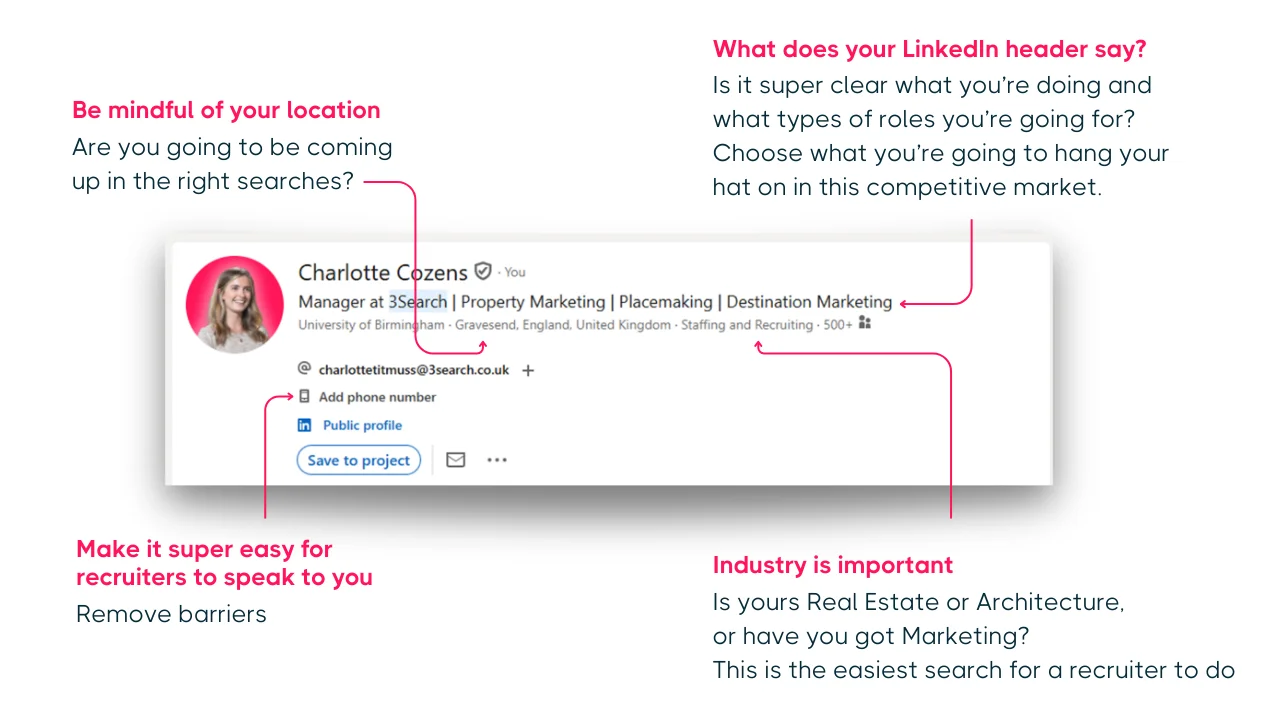
Choose the right location
Recruiters search by postcode radius, usually 5, 25 or 50 miles. If your profile lists a small town rather than a major city, such as London or Manchester, you may be eliminated from talent searches instantly.
Add your contact details
No phone number = another hurdle for recruiters. Make it easy for them to reach you.
Select the correct industry
This is one of the most common issues we see. Many candidates in marketing mistakenly categorise themselves under 'Marketing & Advertising', which makes recruiters assume they work for an agency.
For property marketing professionals, Charlotte advises selecting one of:
- Real Estate
- Construction
- Architecture & Planning
Choosing the wrong industry means you won’t appear in industry-filtered searches.
2. Nail your headline
Your headline acts as a search prompt, so make it specific, keyword-rich and reflective of what you want to be known for.
“Think about all the different keywords someone might search for. You want to come up in as many searches as possible.”
You should consider including:
- Your seniority
- Your specialisms
- Your sector background
- Relevant keywords (e.g., CRM, PPC, HubSpot, regeneration, placemaking, prime, BTR)
Don’t be shy about stacking keywords, it’s truly helpful in ensuring you stand out from the crowd.
3. Your summary and experience should mirror your CV
Your summary is your chance to tell your story: who you are, what you do, and what you’re looking for.
Charlotte’s advice is:
- Treat your summary like the bio at the top of your CV
- Make it clear, concise and keyword-rich
- Put your career goals or job preferences in writing, this increases your chances of being found for relevant opportunities
- Update your experience section so it accurately reflects responsibilities and achievements
- Bullet point stats where possible (e.g. marketing budget, team size, average sales value, footfall)
4. Turn on “Open to Work”
There’s a stigma around the green banner, but Charlotte debunked the myths. Turning on Open to Work boosts you to the top of a recruiter’s results list because LinkedIn prioritises candidates who are most likely to respond to outreach.
“There are so many reasons why having your Open to Work on is beneficial. You’re the first-person recruiters are seeing.”
In case you didn’t know: People inside your organisation cannot see your Open to Work status. Internal recruiters cannot see it.
Here's how to turn on Open to Work
5. Make sure your job titles are searchable
One of the biggest blockers we see? Creative or shortened job titles.
Recruiters search exact terms, such as ‘Marketing Executive’, Head of Marketing’, or ‘Communications Manager’.
If your profile says ‘Marketing Exec’ instead of ‘Marketing Executive’, you may not appear in searches at all.
Working in an agency?
For agency candidates looking to move into an industry role, she suggests adding clarity within brackets. For example:
- Account Manager (equivalent to Marketing Manager)
- Account Director (equivalent to Head of Marketing)
This helps recruiters match your experience to client-side roles.
6. Use the right keywords
Like many industries, real estate has a broad remit. Sector-specific language helps separate you from thousands of generalists.
Working in real estate?
Charlotte recommends including keywords in your profile, such as:
- Placemaking
- Destination marketing
- Regeneration
- Residential
- Super prime / prime / HNW
- Footfall
- Retail
- BTR / PBSA
- Development / mixed-use
These signal instantly to potential employers or recruiters whether you’re right for their particular role.
7. Remove every possible blocker
Everything Charlotte covered comes down to one principle: Make your profile easy for recruiters to find, understand and match to a real search.

The key takeaways are:
- If you don’t appear in searches, you won’t receive messages.
- If recruiters can’t see what you do quickly, they won’t shortlist you.
- If key keywords aren’t on your profile, LinkedIn’s algorithm simply won’t surface you.
Take away any blockers as to why you might not have a recruiter in your inbox about a job.
Are you currently job hunting?
Searching for a new role? The success you have can largely depend on the current state of the job market. To get ahead of the curve, it’s important to build strong relationships with your professional network.
Updating your LinkedIn profile is a quick win, but one that compounds over time. The clearer and more optimised your profile is, the more opportunities will come your way, even when you’re not actively looking.
Connect with our recruitment team
3Search is a commercial recruitment agency, supporting brands across the services, tech and consumer industries with their hiring needs.
Continue your job search by applying to our vacancies here and connect with our recruiters. You can also find us on LinkedIn.