

There are three ways to sell on Amazon as a business – Vendor, Seller and a hybrid of both. We’re seeing a growing number of brands move towards the latter. The hybrid model has been positioned as the answer to AVN challenges, pricing pressure, and assortment gaps. But is it really the quick fix people hope for? Or is it far more complex?
In this article, we’ll reveal the advice from three industry experts as they explore:
- Why Amazon brands implement the hybrid model
- Benefits of the hybrid model
- Drawbacks of the hybrid model
Considering what selling model is right for your business? Find out more about Amazon Vendor Central and Seller Central, by visiting our article that breaks down what each model offers.
About the contributors
At our ninth Amazon Community event, we brought together three industry experts with over 30 years of ecommerce experience between them:
- Charlotte Myles, VP Client Development International at POTOO
- Josh Clarkson, CEO & Digital Commerce Consultant at Edify Consulting
- Clara Perez, National Account Manager at Panasonic
Together, they unpacked one of the most hotly debated topics in the Amazon ecosystem: the hybrid model. Below is a breakdown of the full discussion.
What is the hybrid model?
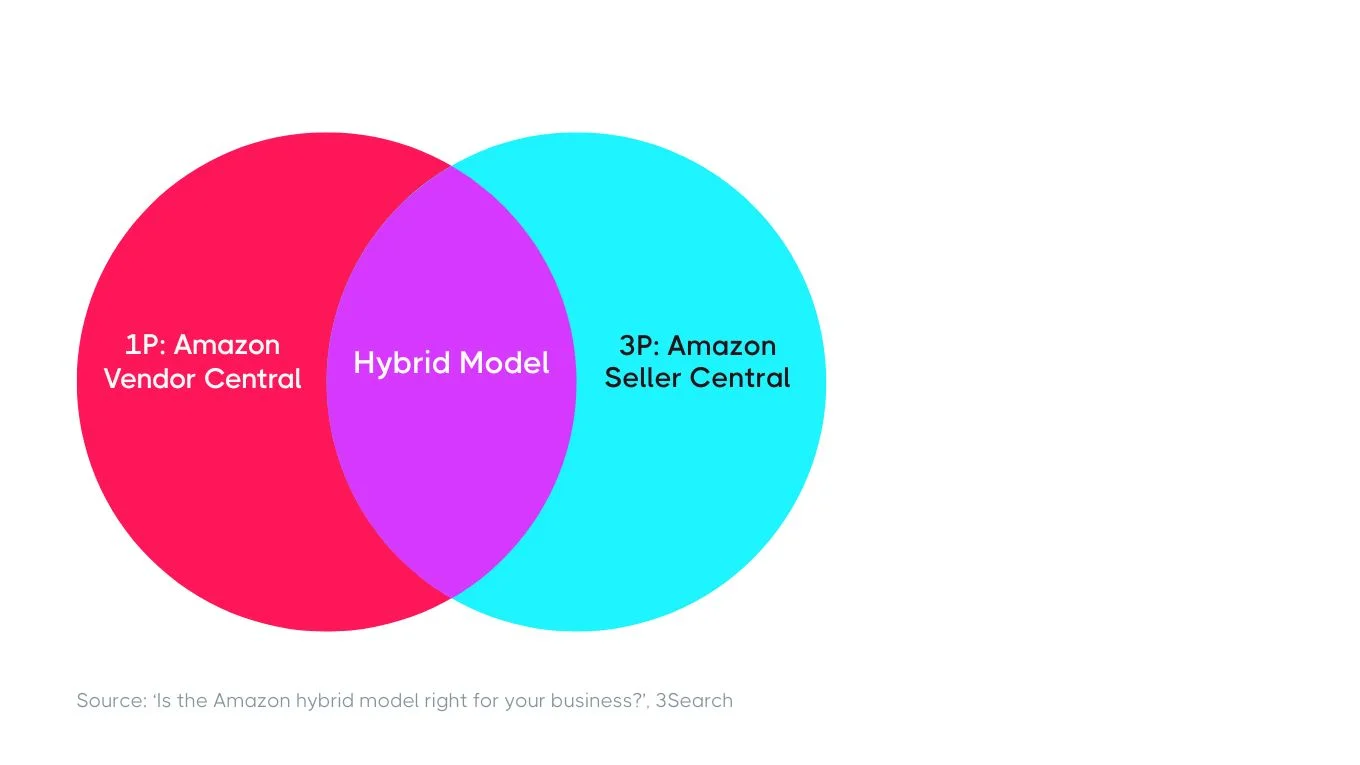
The Amazon hybrid model is where your business uses a combination of both Vendor Central (1P) and Seller Central (3P) at the same time. This gives brands control and convenience:
- Seller Central allows brands to sell directly to customers, giving you full control over pricing strategy and inventory management.
- Vendor Central conveniently has Amazon handle logistics, shipping, and customer support for you.
Hybrid allows the flexibility and benefits of both business models.
Why brands use the hybrid model
While there are both positives and negatives to taking a hybrid approach, there are always business cases. Here are some of the main reasons that brands use both 1P and 3P:
To sell products Amazon won’t take on 1P
Amazon doesn’t allow certain products on a first-party basis. These include:
- Slow-moving or low-volume SKUs
- Hazardous or highly-regulated goods
- Perishable goods
- Customisable products
These items often need to be fully controlled by the vendor. For instance, fresh food needs to be packaged in a particular way.
To respond to inconsistent Amazon ordering
Hybrid acts as a buffer when Amazon reduces orders or deprioritises a category. Leveraging third-party selling is especially important for items that have lower orders.
Clara Perez said, “I think there are some scenarios where 3P is the only way and Amazon will recognise themselves, ‘I actually don’t want to sell this product.’ [... They] can't have a location in the warehouse for an item that sells 0.5 a week.”
To manage returns and open-box stock
Brands that receive a lot of returns often use 3P in order to monetise these units.
To stabilise the customer experience
It can be beneficial to have premium products on the Vendor model, where you can be supported by Amazon to deliver the appropriate customer service.
Josh Clarkson said, “Think about the end-to-end journey. Think about what [experience] the consumer is going to get. Do you have enough people to man the telephones and chatbots so that you can deliver a proper customer service when things go wrong?”
To expand into other markets
Hybrid becomes a stepping stone to selling across Europe or globally.
To solve internal assortment gaps
Hybrid allows brands to test ranges, launch innovation and retain control where 1P terms are unsuitable.
Benefits of the hybrid model
While hybrid is not the universal solution it’s often portrayed as, our three experts agreed that there are meaningful advantages when used strategically. Here are five benefits of hybrid selling on Amazon:
#1 Improved product availability
By using both Seller Central and Vendor Central, brands can list items that Amazon rejects or deprioritises. This prevents lost sales.
#2 Flexibility and control
3P allows brands to:
- React quickly to demand
- Fix availability gaps
- Adjust pricing or promotions independently
By also utilising the 1P model, brands get the benefits of Amazon managing logistics, shipping, and customer support for certain products.
#3 Protection for high-value products
By selling directly, brands can ensure:
- Specific packaging is used
- Warranty support
- Trustworthy fulfilment
Although your business might have specific third-party sellers that you trust, your customers might not. With the likes of Which? warning customers away from third-party sellers, you may find that higher priced products perform better on the 1P model.
#4 Better management of returns
3P gives brands greater control over how refurbished or open-box units re-enter the market.
#5 The opportunity to test and learn
The detailed customer and sales data gathered from Seller Central creates a unique opportunity to test and learn in Vendor.
This is especially useful for those looking to expand into a new territory. Brands can test new markets through 3P before building a relationship with Amazon.
Drawbacks of the hybrid model
As with anything, there are drawbacks to the hybrid model. Here are some factors to consider when approaching the topic:
#1 Operational complexity
As Josh said, the decision to move to Seller “all comes down to operations and logistics.”
“It’s just a shift in the P&L. You can make a much better gross profit if you go to Seller, but you have to absorb all of those operational costs, especially if you don't already have direct consumer or some form of third party that's supporting you and selling. If you’ve not got them, scrap the idea completely.”
Brands often underestimate the lift required in:
- Packaging
- Customer service
- Fulfilment
- Returns processing
- Insurance
- Account health
If you rely completely on Amazon to handle all of the above for your business, you will see a significant increase in costs.
#2 Risk of severe margin erosion
As above, Charlotte Myles shared a story that resonated across the room, “Everyone said the hybrid model was amazing. When we reconciled the P&L, it was minus over half a million.”
Costs build quickly:
- Two supply chains
- Fulfilment fees
- New packaging
- Customer service
- Advertising overlaps
- Amazon penalties
All these factors will eat into your profits.
#3 Cannibalisation between 1P and 3P
Without careful planning and constant monitoring, brands using both 1P and 3P can compete against themselves.
#4 Internal resistance and politics
Taking the hybrid route impacts more than just the Amazon account management team. It disrupts:
- Distributor volume
- GM scorecards
- Finance processes
- Supply-chain planning
Charlotte shared the importance of bringing onboard cross business partners, “My advice is to really think about who's having the worst time with these models and make sure that they are actually your biggest champion.
My recommendation is to go up, share the pain, share the information. And when they realise that you are also seeing this and wanting to resolve it with them, you’ll build some of the best relationships.”
#5 Complicated post-launch governance
There are a number of challenges that businesses tend to face when they first introduce 3P. Competition is strong. As Charlotte said, “There are thousands of sellers. You become just another one — and they’re better at it than you are.”
Final thoughts: Is hybrid right for your business?
The hybrid model can unlock meaningful advantages, but it is not a shortcut, a silver bullet, or a one-click solution.
It requires:
- A clear rationale
- Strong operational foundations
- Cross-functional support
- Financial discipline
- Ongoing monitoring
A big thank you to our speakers for their contributions
We want to extend a huge thank you to Charlotte, Clara and Josh for joining us at our recent Amazon Community event, sponsored by Xnurta and Carbon6. If you missed out on this event and would like to join us at our next one, keep an eye on our events calendar here.