
How new marketing skills can facilitate growth
18 Mar, 2026
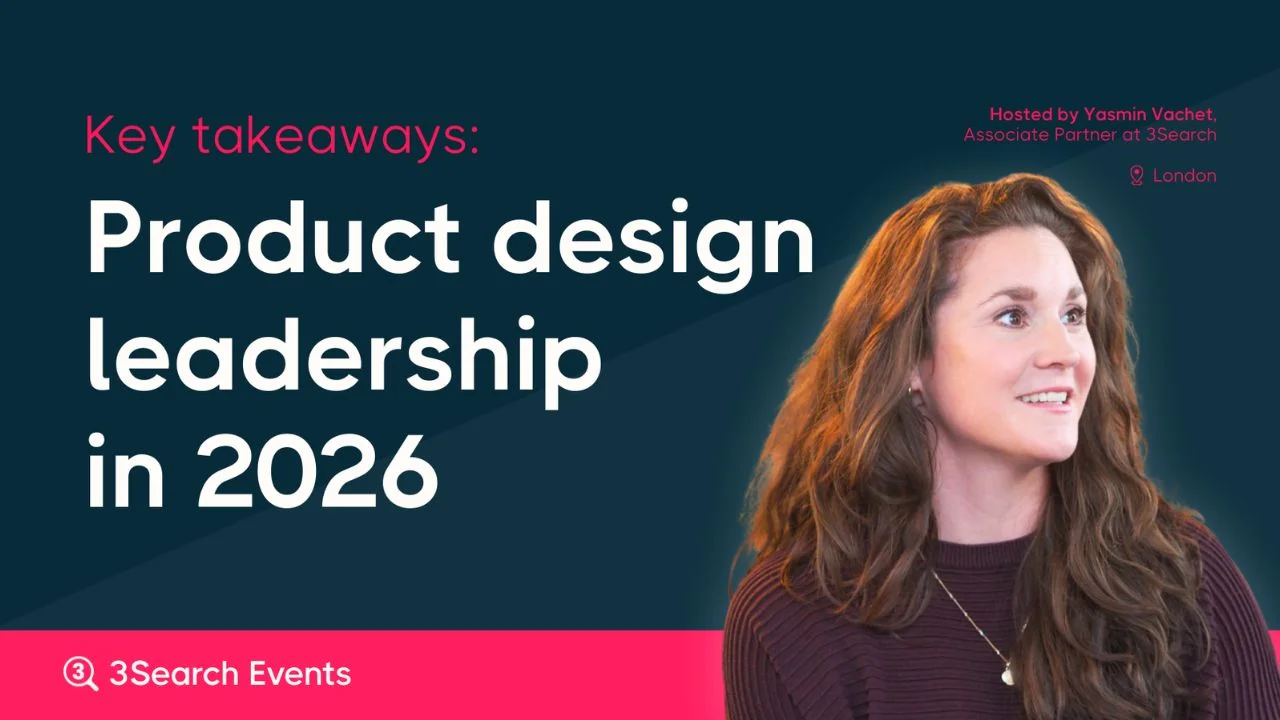
On Wednesday, 28th January, specialist product design recruiter, Yasmin Vachet, held a roundtable event for her community of leaders. Kicking off the year, Yasmin brought together a varied group of Product Design Leaders to discuss the challenges, opportunities and trends they’re currently seeing in their roles.
This article recaps the key takeaways from the conversation, including:
From the use of artificial intelligence to role frustrations, there were a number of common challenges raised by the Product Design Leaders we spoke to, including:
Wellbeing and sustainable leadership is a very real challenge for modern Product Design Leaders. Currently, the role sits in a constant state of “urgency and trade-offs.” Yasmin framed the dilemma, “When everything is urgent, what does one do? Do you sacrifice craft, judgement or yourself? I would hope not the latter.”
That tension was echoed in how leaders described the day-to-day emotional load of the job. There is certainly a feeling of isolation that can come with being the most senior design person in a business.
One participant said design leadership can be “a lonely and sometimes difficult place to be,” because design leaders do not always have peers in the same way that product or tech leaders do. That isolation is compounded by unrealistic role expectations.
The player-coach leadership style sees a leader actively contributing to the hands-on, day-to-day work, whilst simultaneously managing, mentoring, and leading their team.
This is a growing trend in product design teams. The challenge comes from companies wanting Product Design Leaders to move beyond “stepping in when necessary” to requiring someone who can still produce “detailed Figma portfolios” and “pixel perfect” execution on demand.
This is a highly unrealistic expectation. As you move further into leadership roles, you naturally move away from executional work.
Product Design Leaders are framing AI as less of an exciting new capability and more as a source of pressure and uncertainty inside their teams.
This pressure is impacting on a team and individual level. One participant described “the push for us all to be using [AI] but without any real guidance how,” making it difficult to know the right direction to lead the team in. Additionally, AI is creating tension among team members because “some people are really into it” while others are “putting their head in the sand.” The difference in processes is causing frustration.
Design Leaders agree that artificial intelligence “is a great tool if it fixes problems we already have”, however many companies are “using it to fix problems we just invented”.
The group discussed how the AI “hype cycle” can lead businesses to use AI to deliver solutions that customers did not ask for, rather than applying it thoughtfully to genuine user or operational pain points. There is a clear need to re-centre design principles in thinking and planning.
However, there is also a growing concern that AI is leading to the erosion of the early stages of design processes. Product Design Leaders have described hearing designers say, “I don’t have enough time to think.” Ultimately, AI is intensifying people’s expectations and therefore leaving less space for judgement and long-term problem solving.
There was also time to discuss how Product Design Leadership can progress in 2026. Opportunities include:
Product design does not always have a seat at the table, so leaders must understand how to influence those that do. To achieve this, you must have the ability to translate design into what the organisation genuinely cares about.
One participant described influence as the skill of clearly communicating in a way that lands with stakeholders. There is a common assumption that influence is earned by “talking about money,” but it is “a bit of a fallacy” to think the only thing leaders care about is commercial impact.
Instead, they argued that influence is built when a leader can articulate the problem, the solution, and how to get it delivered.
Empowerment was another key opportunity shared by the Product Design Leaders in the room. One participant shared that they are achieving this by specifically training designers “to ask questions and to break the brief,” rather than treating the brief as something to execute unquestioningly.
What matters here is the intent: the goal is not to be difficult or “counter” for the sake of it, but to make questioning part of the job, helping teams “be empowered and think differently.”
The most practical expression of this was the habit of forcing clarity on outcomes: “Tell me what problem that’s solved.” In other words, authority is rebuilt when designers shift conversations away from outputs and towards purpose, impact, and trade-offs.
A huge thank you to the Design Leaders for sharing the product design trends we expect to see this year - it’s clear that the sector is changing in real time.
If you need to engage Product Designers for your business, be sure to get in touch with a specialist digital design recruitment agency, such as 3Search. Additionally, thanks to our commitment to developing your team, you’ll have exclusive invites to events such as these.