
For years, the Product Manager role has sat at the center of product development, balancing customer needs, business priorities, and technical feasibility while guiding businesses toward the right outcomes.
But AI is changing that role faster than many organisations realise. Specialist product recruiter, Francesca Jackson-Burnham, has operated in the sector since 2017. In that time, she has seen the rise of product management to become one of the core drivers behind business success.
Now, she says, “The PM role is evolving and I think ‘Product Builder’ may become the defining product profile of the AI era.”
Learn more about the Product Builder role and the future of Product Managers in this article.
Is it the end of the Product Manager?
Historically, Product Managers were often judged on their ability to prioritise backlogs, manage stakeholders, and maintain alignment between teams. The execution of the product roadmap largely depended on others.
For example, if a Product Manager wanted to test an idea, they typically needed support from design, engineering, research, or data teams to bring it to life. Even simple experiments could take weeks to organise.
Today, AI-powered tools are dramatically reducing that dependency.
The impact of AI on the Product Manager role
With the introduction of artificial intelligence, a Product Manager can now:
- Conduct initial customer research using AI tools
- Create wireframes and mockups in minutes
- Build interactive prototypes with no-code or low-code tools
- Generate requirements and user stories faster
- Test concepts before engineering investment is required
- Validate ideas at a fraction of the traditional cost
This doesn't mean Product Managers are replacing Product Designers or engineers. Rather, they're gaining the ability to move from idea to validation much more quickly. The result is a product team that operates with greater autonomy and speed than ever before.
As a result, the traditional boundary between product strategy and product execution is starting to blur. The question is no longer whether AI will change product management; it's whether the role itself is evolving into something new – the Product Builder.
What is a Product Builder?
The Product Builder job is a hybrid of the Product Manager, Designer, and Engineer roles. They bridge the gap between discovery and delivery. No longer treating each as separate functions, Product Builders scope out the project before moving into Claude Code to build and experiment with the product itself.
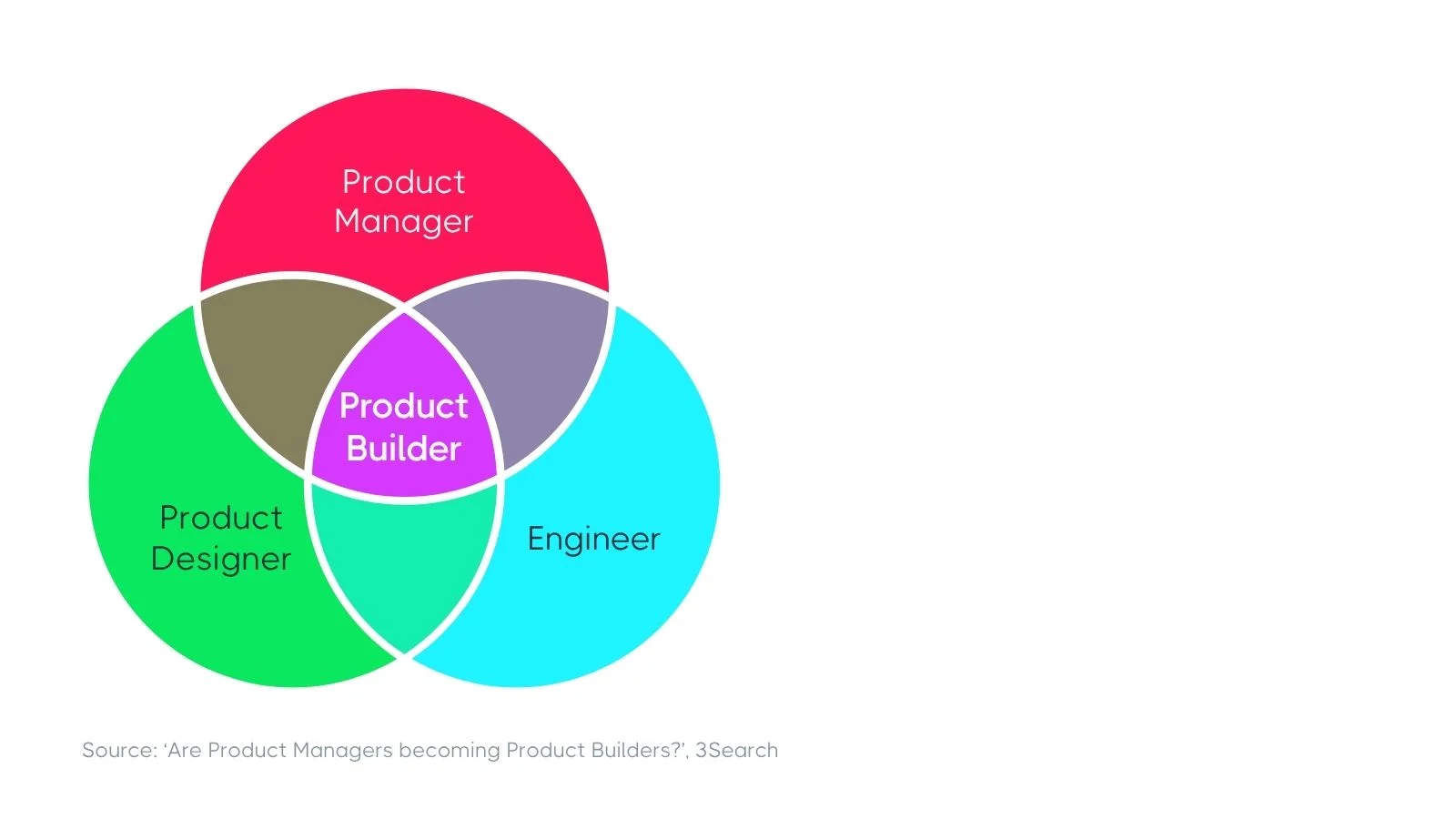
It comes as a result of a significant change in capability where the modern product professional is increasingly expected to do more than manage the process. Now, many Product Owners and Managers are expected to build.
These are not expected to be ready to ship digital products, but enough to:
- Explore opportunities
- Test assumptions
- Gather customer feedback
- Demonstrate value
- De-risk future investment
An example of a Product Builder
A Product Builder at travel SaaS company, Mews, says, “I am not here to wait for a perfect spec, pick up a ticket and disappear after the merge. I am here to find worthwhile problems, validate them quickly, build the thing, ship it and stay close enough to see whether it actually helped.”
What this means for Product Managers
The introduction of the Builder title has been somewhat controversial amongst the product community. However, many argue that when a PM can research, prototype, and validate on a day-to-day basis – the job has changed.
In many organisations, the fastest-moving Product Managers are already behaving as Product Builders. They're running experiments independently, creating proof-of-concepts, and presenting working prototypes without being asked.
How should Product Managers react?
As we've clarified, one of the most significant impacts of AI is the compression of time. Not only can Product Managers move faster, but they’re expected to.
Judgement and taste is a critical skill as AI accelerates productivity. As tools become increasingly accessible, execution becomes commoditised. What remains scarce is judgment.
The best product professionals will still be distinguished by their ability to answer fundamental questions:
- What should we build?
- Why does this problem matter?
- Is this the right opportunity to pursue?
- What customer need are we solving?
- Will this create meaningful business value?
AI can generate hundreds of ideas, but it can't reliably tell an organisation which idea is worth investing in. That's the difference that product talent – be it Builder, Manager or Owner – brings.
Skills defining the next generation of Product Leaders
As the role evolves, the skills that organisations prioritise are shifting. Traditional strengths such as stakeholder management, prioritisation, and communication remain important but may no longer be enough on their own.
Increasingly, businesses will look for product professionals who can combine strategic thinking with hands-on experimentation.The strongest Product Builders are likely to be:
- Customer obsessed: A deep understanding of user problems remains the foundation of great product decisions.
- Commercially aware: Knowing how decisions connect to revenue, retention, and growth becomes even more important as teams move faster.
- Curious: Not every Product Manager needs to be able to code, but understanding what tools can achieve is becoming a significant advantage.
- Experimental: Product Builders are comfortable testing ideas, learning quickly, and validating assumptions with evidence rather than opinion.
Are Product Builders the future?
The Product Manager title will not disappear overnight (maybe not ever), but the expectations of the role are clearly evolving.
AI is making it possible to iterate faster than ever. As such, organisations increasingly need people who can move seamlessly between strategy and execution. They need professionals who can identify opportunities, test ideas rapidly, and create momentum without waiting for large teams or lengthy processes.
The Product Manager role isn't shrinking – its influence is expanding.
Looking for your next product hires?
If you’re looking to build a product team that is equipped for the future, get in touch with our specialist recruitment team. With our Advise, Attract, Develop approach, we’ll identify the challenge your business is facing before identifying the right talent to fuel growth.