
Marketing has never had more influence at board level, and yet, representation tells a very different story. Across UK boardrooms, Non-Executive Director roles continue to be shaped by traditional pathways, including finance, legal and operational leadership.
Despite significant interest in the role from marketers, the path often remains unclear – poorly understood, relationship-driven, and often inaccessible without the right networks or prior board experience.
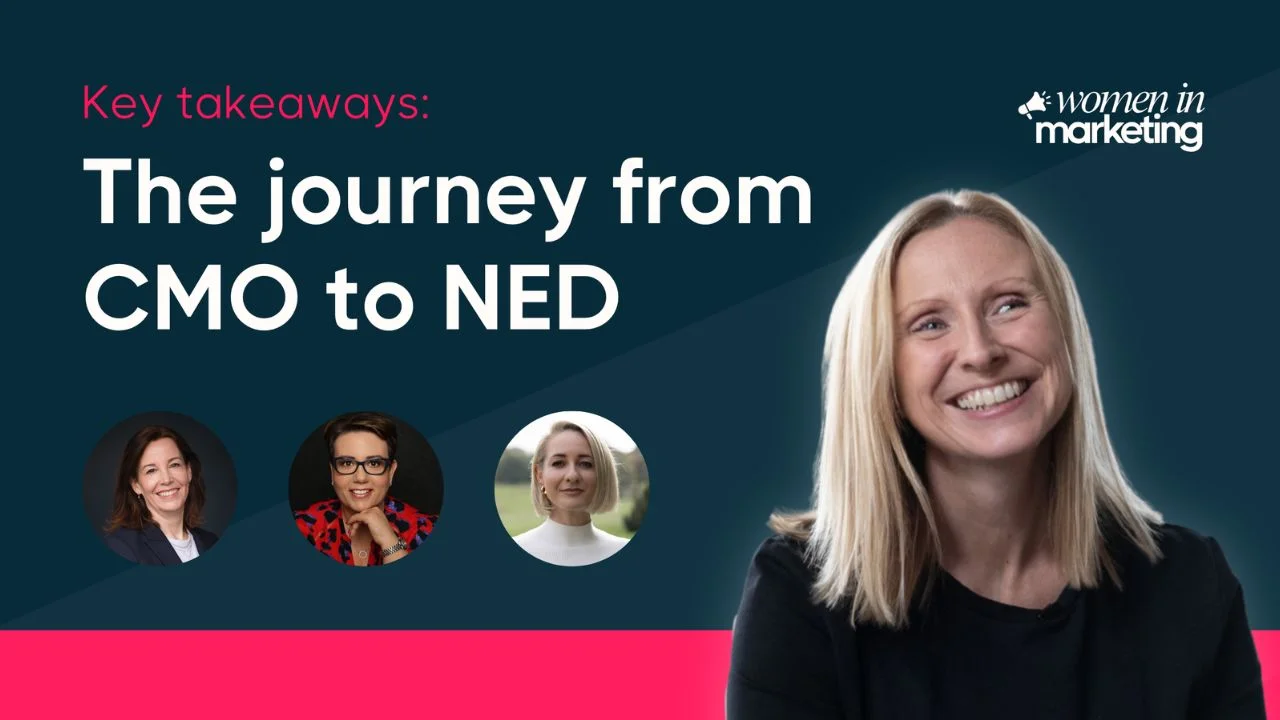
In this article, we recap the key takeaways from our exclusive Women in Marketing community event on June 3rd, Senior Director, Liz Hopkins, sat down with three successful marketers turned NEDs to discuss their career paths. Attendees heard from:
- Lucy Sinclair - A former CMO turned Non-Executive Director, Lucy has built a diverse portfolio specialising in mid-market PE-backed businesses, sitting on the boards of Eurostar, Ambassador Cruise Line, Il Lanificio fashion house in Milan, Red Funnel ferries and BHID luxury furniture group.
- Célia Pronto - Célia is an award-winning Board Director with 30+ years of Executive Leadership across a range of industries and sectors. She currently serves as a NED at South East Water, Moto Hospitality, Samworth Brothers, Direct Wines and Campden BRI, contributing to governance, commercial oversight and strategic direction across each.
- Tracy Woods - A senior marketing and growth leader with extensive experience operating at executive level across high-growth, consumer and digital brands. Tracy is currently CMO at Lookers Motor Group Limited and has held a series of senior leadership roles.
Continue reading for the key takeaways from their conversation.
Why should marketers consider the NED role?
For many CMOs and senior marketing leaders, the move into a NED role is increasingly appealing. It offers broader strategic influence, portfolio flexibility, and the opportunity to operate at the highest level of decision-making.
What a NED role actually involves
The Non-Executive Director role is still incredibly misunderstood, particularly for those coming from executive careers in marketing. At its core, the shift is simple but significant: NEDs are not there to run the business but to ensure it is run well.
For CMOs, this is a fundamental change in how they deliver value. Executive roles are defined by ownership, delivery and outcomes. By contrast, board roles centre on:
- Governance and accountability
- Strategic challenge and direction
- Oversight of leadership (including hiring or removing CEOs and CFOs)
- Risk, culture and long-term sustainability
As a NED, you are operating at a distance from day-to-day. You are expected to hold a helicopter view, making decisions and contributions without being in the detail. This requires a completely different skillset.
Influence, not control
A critical distinction is that NEDs do not have direct control over outcomes. Instead, they must influence through challenge, questioning and perspective.
This is often one of the hardest adjustments for senior marketers. As discussed during the panel, the role is not about instructing teams but about shaping thinking through subtle shifts in language and framing. The most effective NEDs create impact by asking better questions, not by providing all the answers.
Variety in different roles
While the core responsibilities are consistent from organisation to organisation, how the role plays out varies significantly depending on the business.
Ownership structure is a major factor. As Lucy Sinclair outlined, board dynamics differ widely between PLCs, private equity-backed businesses and family-owned companies, ranging from highly governance-led environments to more hands-on, advisory-style roles.
In private equity-backed or growth businesses, for example, NEDs are often expected to be more involved, acting as a coach, challenger and sounding board to the executive team, while still maintaining independence.
A different kind of accountability
Ultimately, the NED role is not a step back from executive life, but a shift into a different kind of accountability.
You are no longer responsible for delivering the plan, but you are responsible for ensuring the right plan is in place and that the business has the leadership, structure and discipline to deliver it.
For senior marketers considering the transition, understanding this distinction early is critical. Success at board level depends not on how well you can execute, but on how effectively you can guide, challenge and influence from a distance.
The challenge of moving from CMO to NED
Despite marketing becoming increasingly central to growth, board composition has not evolved at the same pace. In 2026, boardrooms continue to be shaped by traditional definitions of leadership, with finance, legal and operational backgrounds dominating, not necessarily because they are more relevant, but because they are more familiar.
This creates a structural bias in how boards assess “readiness” for Non-Executive roles. This often excludes senior marketers by default.
The challenge is compounded by how NEDs are appointed. As Tracy Woods described, “It is a bit of a black box when you start trying to enter the world. It’s very much about who you know rather than necessarily what you know.” Unlike executive hiring, NED appointments are often not driven by open processes or clearly defined criteria. Instead, they are relationship-led, often filled through trusted networks and informal referrals.
What this means for female marketers
By appointing NEDs in this manner, a cycle is created. Boards hire from existing networks, which tend to reflect similar backgrounds and experiences. For marketing leaders, especially women, this creates both a visibility gap and an access gap.
Even highly experienced executives can find themselves starting over, building new relationships and connections to secure that next step. As Célia Pronto put it, “You genuinely have to build your credibility because you are starting again… it’s like you’re a graduate.”
The opportunity: boards need marketers
This underrepresentation contradicts what boards need. As businesses navigate complex, customer-led growth challenges, expertise in brand, customer experience, digital transformation and communication have never been more critical.
Our speakers repeatedly referenced stepping into organisations where this perspective was either missing or undervalued, despite being central to long-term value creation. Ultimately, there is a clear opportunity for marketers to step into the Non-Executive Director role.
How can CMOs become a Non-Executive Director?
We’ve established that there is no defined pathway for marketers moving to Non-Executive Directors. So, how do you approach the move to NED? Our speakers shared their own career journeys and practical advice to move forward.
For many, the first role requires a sustained effort of repositioning, networking, and persistence rather than a direct progression from executive leadership.
Build while you’re still in role
Célia highlighted, “it can take you up to three years to get your first NED role.” Rather than waiting until you are ready to step away from an executive career, you should begin building towards a NED position in parallel. This often includes:
- Taking on trustee roles or advisory board positions
- Leading cross-functional committees internally
- Gaining exposure to governance, rather than delivery
As Lucy Sinclair reflected, much of her early experience came from “board-like” environments (committees, trustee roles and industry groups), which later became critical in positioning her for formal NED opportunities.
Networking is key
Unlike executive hiring, which has become more structured, the route into NED roles remains heavily network driven. Ultimately, visibility drives access to Non-Executive positions.
Our speakers shared the importance of networking with intent:
- Consistency matters: building relationships over time, not when you need them
- Proximity matters: connecting with people already sitting on boards
- Clarity matters: being explicit about your interest in NED roles
Célia Pronto described networking 2-3 times a week to build visibility and credibility early. Other practical advice included:
- Asking each new contact for introductions to two relevant people
- Leveraging board-focused communities and events
- Proactively telling senior contacts and chairs that you are exploring NED opportunities
The tipping point after securing the first role
Despite the challenge of getting started, there is a clear shift once the first NED position is secured.
Our speakers described a noticeable acceleration in opportunities after that point, with inbound interest increasing and search firms becoming more engaged. As Tracy Woods noted, “once you sit on one board, suddenly the opportunities start to ramp up – the search firms are suddenly banging down the door.”
The first appointment provides proof of capability within a board context, making future appointments significantly easier.
Progressing you marketing leadership career
The route to becoming a Non-Executive Director is rarely linear, particularly for women in marketing. But as the insights from Lucy Sinclair, Célia Pronto and Tracy Woods show, the opportunity is real for those willing to build board-level credibility, strengthen the right networks and reframe their experience through a governance lens. As boards face increasingly complex growth challenges, the commercial, customer and brand perspective marketers bring has never been more valuable.
If you are considering your next move at board level, 3Search’s dedicated search practice works with senior marketing leaders and businesses to navigate critical leadership transitions. Whether you are exploring your first NED opportunity or looking to strengthen your board with commercial marketing expertise, our team can help you understand the market and make the right connections.