
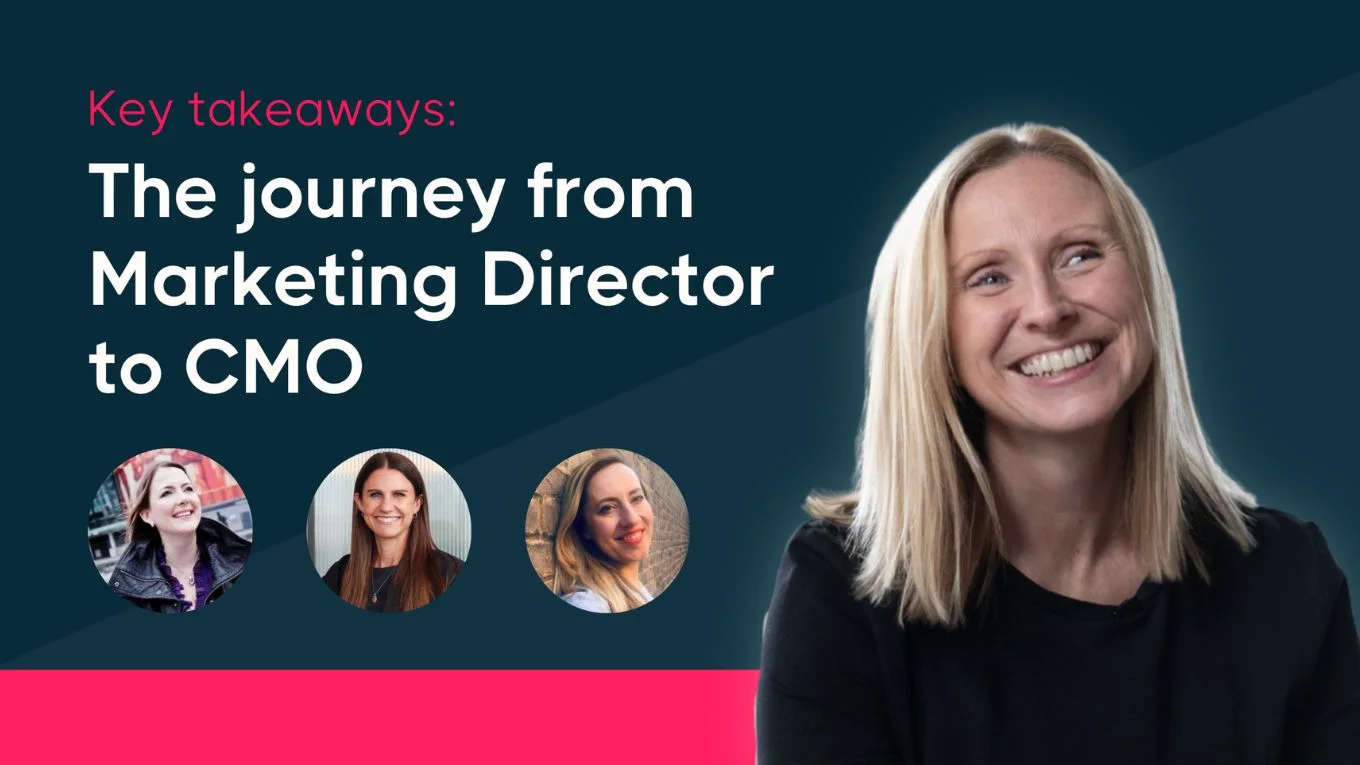
Climbing the career ladder to the C-suite is daunting, no matter how experienced you are. To help our marketing community navigate the journey from Marketing Director to Chief Marketing Officer (CMO), Liz Hopkins from our marketing recruitment team, hosted a breakfast seminar at the RAF Club in London on Tuesday 3rd November.
The event brought together a panel of marketing leaders to talk through their career journeys and provide our marketing community with useful insights on how they can chart their own path. Liz was joined by:
- Caroline Finn, CMO at Grace & Stella
- Elly Sherwin, CMO at Fundment
- Ada Babiuch, CMO at Ocean Bottle
There are many routes to the C-suite
What was clear from our panellists' career paths was that no two journeys look alike.
- Elly was seconded from an agency into Silicon Valley Bank for six months, said yes to every opportunity and built her experience across the UK, China and the US. It was then that an exacting internal process – involving psychometric tests and several rounds of interviews – landed her the global CMO role.
- Ada jumped from The Walt Disney Company into a B2B tech start-up, trading a linear promotion path for a bigger title.
- Caroline moved from Chief Digital Officer, through maternity leave and a stretch of interim work, to her first CMO seat covering for the incumbent.
So if you're concerned that your career path seems inconsistent, you can approach the boardroom from many angles.
What shifts as you move from marketing leader to business leader?
The biggest shift you'll experience on your career journey is that you'll stop being just a marketer. Ada had expected the job of CMO to be full of creative discussions and brand vision, while the reality was commercials, KPIs and cross-functional problem solving. It was also important to have a strong point of view in discussions with the CEO and other C-suite peers.
As a CMO, you're shaping the growth agenda as a partner rather than a subordinate. "The buck stops with you," said Elly, "and there is no backstop." That means thinking in quarters and years rather than weeks, and spending around 30% of your time externally with customers and at events. You can't do everything, so it's important to hire the best people, empower them and decide what is truly yours to own.
What should the CMO demand from the C-suite?
Having access to information, and a proper seat at the table, are non-negotiables as a CMO. If an offer doesn't put marketing at the exec table, "that should ring an alarm bell, because it says what they think about the value of marketing at that point," said Elly.
Ultimately, the quality of your relationships will underpin your success as a CMO. "If, for example, the first time you're meeting with your CFO is to discuss the budget, you've kind of lost something along the way," she said. "You need to have built those relationships and that trust... and that makes those discussions a lot easier." Having an honest, transparent debate in leadership conversations is a sign that you have healthy relationships in place. When you feel you can't speak to your peers honestly, "there is something to fix there," said Ada.
How to win over the CFO
How do you build a relationship with the CFO that shows that marketing is not a cost centre, but a genuine contributor to business growth? It's important to learn how the P&L works, ideally by leading or owning one, and translating marketing results into commercial results.
- Find out what motivates your CFO: Elly built a joint business case for an analyst who would support both her team and her CFO's regional ambitions. Caroline's early relationship with her CFO was based on a two-way learning exchange, helping each to gain an understanding of the other's role. "I can now speak CFO," she joked.
- It also helps to educate yourself: Ada recommended CIM courses and online mini-MBAs, lasting two to three months each, that teach marketers to read and translate the numbers, thereby allowing them to communicate with the CFO in a language they understand.
Working with founders
When it comes to working with founders, patience and resilience are key. That means "you have to have a really good sense of humour, and you have to not take things too personally," said Elly. Although she calls the endless debates over minutiae "the CEO tax," having autonomy and the chance to work at the cutting edge of the business, such as building a team of AI agents for marketing modelling and brand compliance, more than make up for it.
Learn more about working with a founder as a CMO on the 3Search Executive website.
How to become a CMO in 3 years
If you're a marketing professional looking to become a CMO in the next three years, how can you go about gaining the experience you need? Our panel shared their tips:
- Cross-functional projects: Steepen your learning curve by taking on new projects and leading initiatives that you care about. Launches and rebrands, for example, have given Ada exposure to senior stakeholders. But remember that taking on more can lead to burnout, so be realistic.
- Planning: Identify your strengths and gaps, build stakeholder maps and upskill in AI. Elly shared a rule of thumb that every year you've worked equates to roughly a month of searching for a new role.
- Sponsors and coaches: Actively seek a coach who can give you feedback, spot growth opportunities and challenge you. Finding a coach was "an absolute game changer" for Elly, and having a male coach was especially useful in male-dominated rooms.
- An external anchor: Have something that you can anchor yourself to outside of the work environment. This could be an academic or learning interest that you can apply in the workplace. Caroline's behavioural psychology course and MBA gave her useful frameworks and something distinctive to talk about in interviews.
How do you know when to move on?
You should be prepared to move on when you're increasingly asking yourself whether you've learned enough and whether there's space for you to develop further in your current organisation. Each of our panel shared when they knew the time was right for them to find their next role:
- For Caroline, the day-to-day pressure of interim work was a way to learn quickly and assess what she wanted from her career.
- As global CMO, Elly realised that she was triaging and relaying messages between four bosses rather than performing her craft. Having honest external conversations helped her figure out where she wanted to be.
- Ada has also found relationship building to be a key part of her journey, stressing the importance of reaching out to people or organisations you want to work with.
Take the next step on your journey
There is no one way of becoming a CMO. With numerous pathways to the boardroom, what distinguishes you is your personal equity and individual experience. Connecting with other marketing professionals not only allows you to share tips and challenges, but also to build your understanding of what you want from your career. If you'd like to join us at our next event, are looking for your next step up or for more advice on becoming a CMO, please get in touch with our marketing recruitment team.