Creative strategy has quickly become one of the most sought-after disciplines in growth marketing. As platform algorithms evolve and AI accelerates content production, brands are investing more heavily in creative to stand out from the crowd.
Despite growing demand, the role of the Creative Strategist remains difficult to define. Hiring managers often look for different combinations of skills, candidates are entering the discipline from varied backgrounds, and businesses are still working out what “good” looks like.
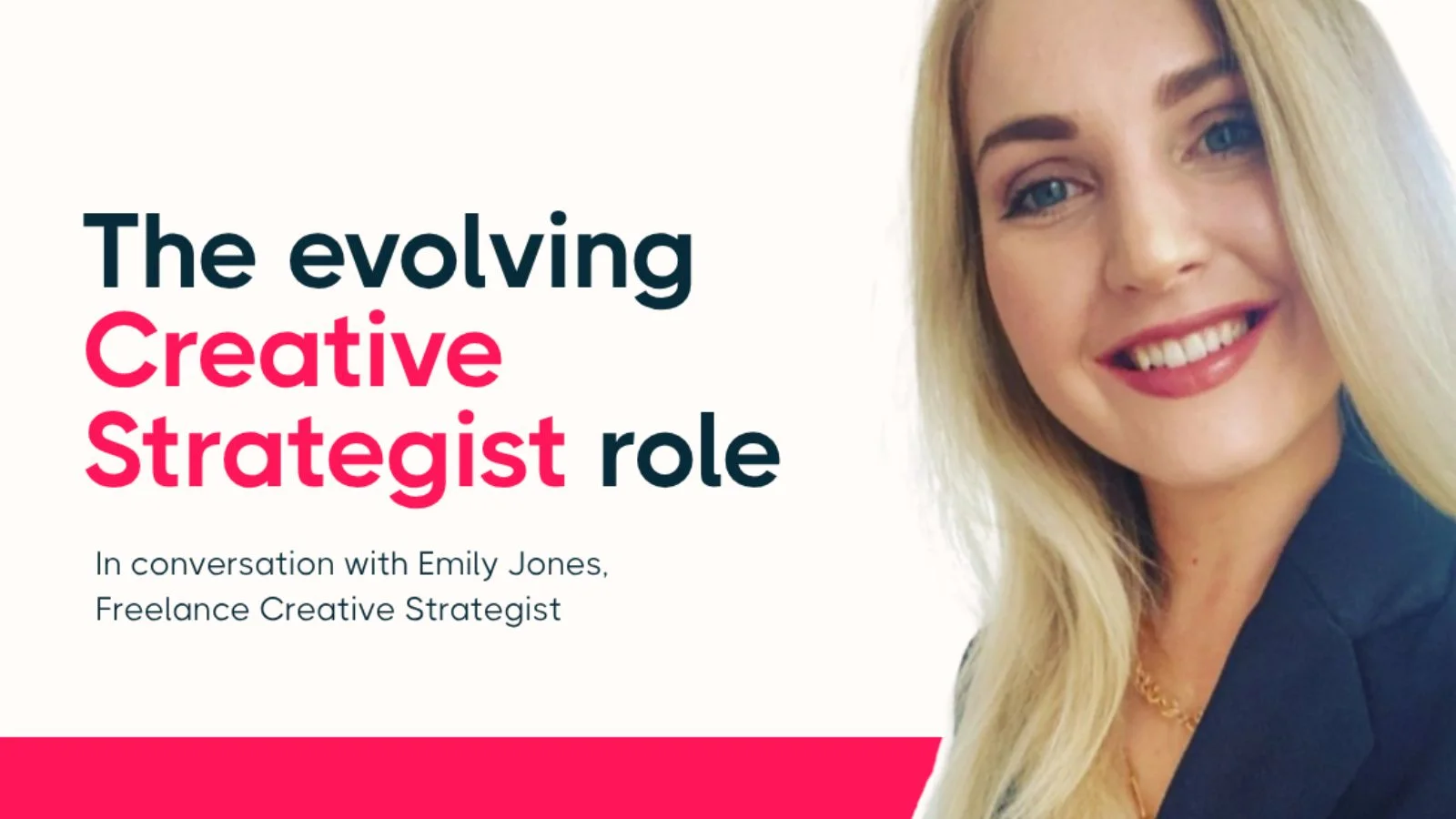
In our recent webinar, Yasmin Vachet, who leads creative and design recruitment at 3Search, spoke with Performance Creative Consultant, Emily Jones, about the evolution of creative strategy. Their conversation covered:
- The rise of the function
- The impact of AI and Meta’s Andromeda
- What both candidates and hiring managers need to understand as the discipline matures
You can watch the full webinar here or read the takeaways below.
Q: Creative strategy is one of the most exciting roles in marketing right now, but it’s still hard to define. What actually makes a great Creative Strategist?
Emily Jones: The reason it is so hard to define is because the role itself is hard. Creative strategy brings together so many different marketing disciplines into one person in a way that feels unprecedented.
There is no single blueprint. The definition changes depending on whether you are speaking to a brand, an agency, a growth team or a creative team. But from my experience hiring Creative Strategists, I am first looking at candidate’s attitude. I'm looking for curiosity, proactivity and being comfortable with there being no single right answer.
You must be excited by the fact that the role is constantly changing. You can demonstrate this in a few ways. For example, if you come from a more creative background, you need to be willing to deep dive into data. If you come from performance, you need to be open to developing your creative judgement.
A lot of creative strategy is also about failing. You might find that only 2 out of 10 creatives become winners in an ad account in any given week. That means you need to be energised by the cycle of testing, learning and improving, rather than disheartened when ideas do not land.
Of course, there are also baseline skills. You need an understanding of media buying, data, consumer psychology, algorithms and commercial growth. Creative strategy largely sits within the growth function, so profitability metrics and commercial outcomes matter. Your knowledge cannot just be about creative ideation in its own right.
Q: From a hiring perspective, why do different businesses define the same role so differently?
Yasmin Vachet: You can have the same job title, but a completely different view of what ‘good’ looks like depending on the hiring manager, the reporting line, the existing team, and the gap the business is trying to fill.
Some teams need someone who leans more towards creative ideation. Others need someone who can speak the language of growth, paid media, and performance. Neither is right or wrong – it depends on the context.
That is why it is so important for hiring managers to define the biggest skills gap they are trying to solve. Businesses often ask for ‘everything and the kitchen sink’, but the reality is that they may need to compromise. The key is working out which skills are non-negotiable and which can be learned.
Emily Jones: Exactly. A lot of job specs in this space are looking for unicorns. But because the discipline is still new, hiring managers need to look for those broader characteristics I’ve mentioned.
Businesses should ask themselves which discipline is most important to have in the building, and which skills can realistically be developed. Some agencies are already building accelerator-style programmes for Creative Strategists because they recognise that getting every skill ‘ready cooked’ is difficult.
Q: If there is no obvious route into creative strategy, how should candidates position themselves?
Emily Jones: Self-awareness is critical. The strongest creative candidates can articulate their superpower clearly. They can say, ‘This is the thing I am great at. This is where I have deep experience. These are the areas I am interested in developing, and this is how I have already started upskilling.’
That attitude and coachability was more important to me when hiring than whether someone comes from a performance, organic, creative, or brand background. If you can explain your experience as a coherent narrative, and show how your skill set applies to creative strategy, you will stand out.
For example, my background was in performance and growth, then pure strategy, comms planning, client leadership and pitching. That gave me a strong platform to lead a team and think commercially.
I am not a video editing expert, and I do not have deep experience running shoots. Sometimes the Creative Strategists are expected to manage these elements, but that is okay. The most important thing is being honest about what you bring and where your gaps are.
Yasmin Vachet: I agree. In a saturated market, candidates need to become very good at advocating for themselves. If you do not have someone articulating your strengths on your behalf, like a recruiter, you must be able to do it yourself.
That means being clear on your strengths but also being hyper-curious. Test new tools, explore new technologies, and think about how you can set yourself apart.
Another point to remember is that Creative Strategists must balance left brain and right brain. They need to be conceptual and creative but also be confident working with growth and performance leaders in the language of metrics, numbers and data. Candidates should be able to articulate both.
Q: Creative strategists often sit between brand and growth teams. How should they balance performance with brand equity?
Emily Jones: This is one of the biggest tensions in the role. Brand teams often care about consistency, craft and long-term equity. Growth teams care about speed, testing and performance. Creative Strategists can find themselves in the middle.
But it is important to remember that it is not the Creative Strategist’s job to balance brand and performance alone. Long-term growth still needs a proper 360 marketing strategy, including channels such as podcasts, radio, TV, out-of-home, and experiential. Performance creative is one part of that wider mix.
The challenge is that social media does not work in the same way it once did. Historically, brand distinctiveness came from consistent assets served over time. But now, the landscape is now more fragmented, the volume of content is much higher, and buying triggers are more immediate.
With Meta’s Andromeda, distinctiveness is rewarded, but only when it is also diverse. Strict consistency can be penalised by the algorithm. That means Creative Strategists must have more nuanced conversations with brand teams about what truly protects brand equity and what might be restricting performance.
Q: Has UGC made the tension between brand and performance even greater?
Emily Jones: Yes, because user-generated content is much harder to control from a brand distinctiveness point of view. There is so much of UGC now that it can become an endless scroll of ‘same same’ content.
But that does not mean UGC cannot feel distinctive. It means brands need to be more choiceful with it. For example, we worked with a brand with a clear idea of the kind of creator who “felt” like the brand. This meant they were able to create guidelines around who should be approached to work with the business.
In this case, the creator selection becomes part of the brand system. It is less about rigid visual consistency and more about choosing people, settings and personalities that embody the audience and the brand’s world.
Q: Can lo-fi creative still build premium brands?
Emily Jones: Yes. Premium brand identity and lo-fi content can coexist, as long as the balance is right across the wider marketing mix. You can have a premium identity across upper-funnel channels while allowing paid social or UGC to feel more native, relatable and trustworthy.
UGC is not one monolith either. Some creators can bring a more premium feel into a lo-fi format depending on their style, experience and execution.
Q: How has Meta’s Andromeda changed the day-to-day reality of creative strategy?
Emily Jones: Andromeda has fundamentally changed how creative is served and tested. It’s Meta’s ad delivery system – the algorithm that decides who sees which ads. It has replaced a lot of the audience-based targeting that media buyers used to rely on.
In the past, targeting, interests, demographics, pixels and lookalikes were the bread and butter of media buying. Now, broad targeting is far more common, and creative-based targeting has become the new focus. The algorithm is reading the actual elements of your content (the hook, visual composition, audience call-out and structure) in much more detail. That means each part of the ad is doing more heavy lifting.
Volume is still important, but identical variations do not work in the same way they used to. Changing one headline while keeping the same visual structure is less useful if Meta reads the ads as the same creative. Distinct creative gets its own shot in the auction; duplicated creative risks competing against itself.
As a result, Creative Strategists need to think about whether ads pass the ‘squint test’. If you squint at a group of ads, do they all look the same, or are they visually and conceptually distinct enough for Meta to treat them differently?
Q: What does this mean for workload and burnout?
Emily Jones: The pressure has increased. Creative fatigue is faster, ads have shorter shelf lives, and teams need more content to replace what stops working. That makes the role busier and more intense.
AI has accelerated partly because teams need it to keep up with the pace and demand of platforms. But more production capacity does not automatically mean better strategy. The Creative Strategist needs to be the ‘sniper’, not the ‘machine gun’. Just because you can make more content does not mean you should. You need to know why you’re making it, what you are trying to learn and what it builds on.
Burnout is a real issue because Creative Strategists are often being asked to ideate, concept, brief, analyse, launch, shoot and manage stakeholders. One person can do many things, but the output will be limited if they are expected to do everything alone. Businesses need to understand the limitations of one role and resource teams accordingly.
Q: Where is AI helping Creative Strategists?
Emily Jones: We are still in the messy middle. Leaders are trying to embed AI into workflows, but everyone is still testing and learning. Sometimes AI speeds things up; sometimes you spend so long sparring with it that it would have been quicker to use your own brain. This will reduce as AI tech stacks become finalised in the next few years.
But for upfront strategy work, AI can do a lot of heavy lifting. Competitor research, customer research, audience research and category research can all be accelerated. Creative Strategists can plug in customer review files, use tools to analyse competitor ad libraries, sync with creative analytics platforms and quickly identify patterns in winning ads and scripts.
The value comes when the Strategist knows what good looks like. Strong inputs and strong judgement are still essential. AI can help synthesise information, but the Strategist still needs to interrogate the output, find the human insight and decide what is worth acting on.
Q: If AI can generate scripts, concepts and visuals, where does human strategic value begin?
Emily Jones: Human value begins with taste, judgement and point of view.
Marketing is still about marketing to humans. AI can synthesise research, crunch data and produce outputs quickly, but it can also flatten language, emotion and nuance. The Strategist needs to ask: Does this hit the human insight? Would someone stop scrolling? Is there tension here? Is there an idea worth building on?
To keep up, Strategists need to stay close to online culture, read widely, understand traditional marketing principles and keep building their commercial experience. AI can help with the heavy lifting, but Creative Strategists are still responsible for turning information into insight.
Q: The role is still being invented. What skills should Creative Strategists invest in now?
Emily Jones: Think of yourself as the conductor of the orchestra, not the expert in every single instrument. You do not need to be the best media buyer, designer, editor, creator and strategist all at once. But you do need to understand enough about each discipline to collaborate, delegate and drive direction.
Commercial understanding is becoming more important. Creative Strategists need to understand break-even CAC, business costs, profitability, creative velocity and what the ad account actually needs. Sometimes the right answer is not more content; it is a sharper testing roadmap and a clearer strategic focus.
Q: If you were starting your career again today, where would you focus your time?
Emily Jones: I would dabble in content creation, UGC and organic content to understand editing, hooks and visual structures. Organic is still highly valuable because many of the strongest ideas come from what is actually engaging audiences in culture.
I would also focus on marketing fundamentals. Traditional marketing theory still matters, particularly when navigating conversations around long-term versus short-term growth.
The future of creative strategy sits across both ends of that spectrum: practical production skills on one side, and deep marketing theory, judgement and commercial understanding on the other.
Creative strategy is evolving rapidly
Creative strategy is still being defined by the people working in it, hiring for it and building teams around it.
For candidates, this creates a unique opportunity. There is no single route in, meaning the emphasis is on soft skills, such as curiosity, commercial awareness, and creative judgement. For hiring managers, it means being clear about what your business needs, rather than expecting one person to solve every creative, strategic and production challenge at once.
As Yasmin Vachet concluded, technology will continue to evolve, but the value is shifting away from execution and towards judgement. In a market where AI can accelerate output and algorithms demand more creative variation, the people who stand out will be those who can combine speed with strategy, content with commerciality, and experimentation with taste.
Work with 3Search for your creative recruitment needs
Whether you’re searching for your next creative role, or preparing to hire your first Creative Strategist, our team are at the forefront of the discipline’s emergence. Using our Advise, Attract, Develop approach, we can identify your challenges and ensure you engage the right talent to unlock growth.