
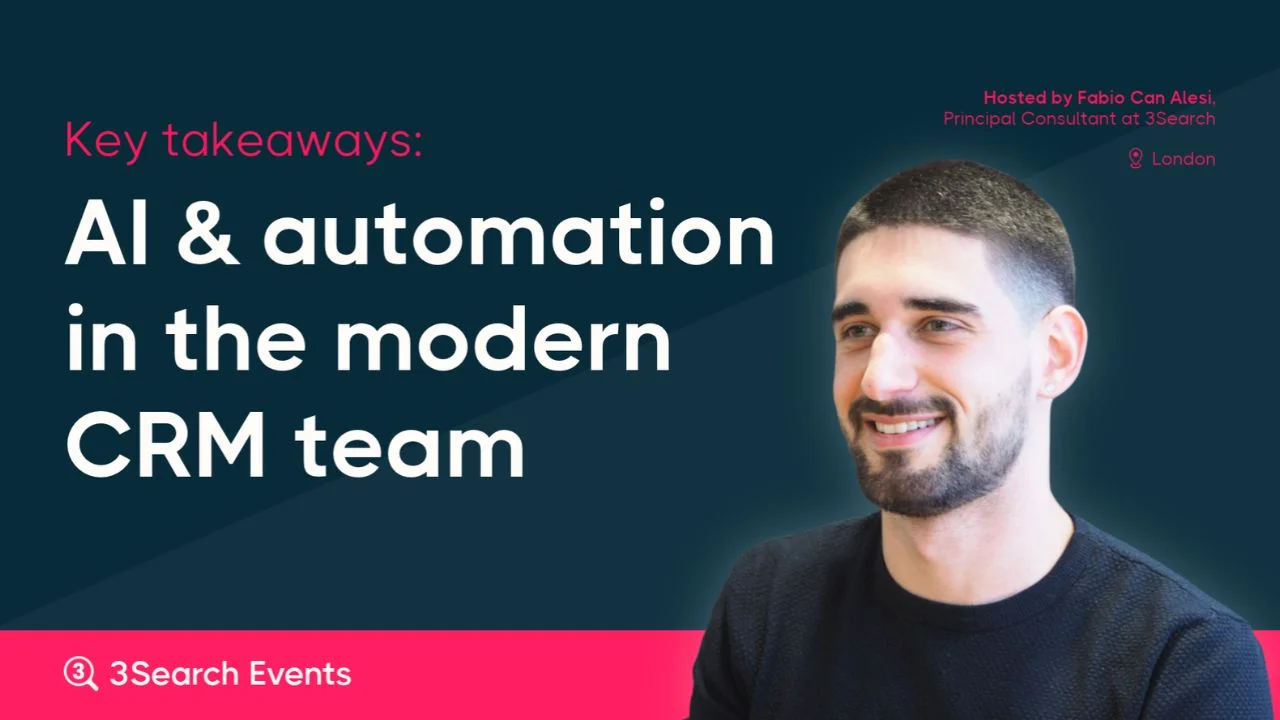
AI is reshaping how CRM teams plan, build and personalise, but who’s really in control: the people, the platforms or the algorithms?
On Wednesday 18th November, Fabio Can Alesi from our loyalty and CRM recruitment team hosted a roundtable event bringing together senior CRM, lifecycle and retention leaders to compare notes on what AI is genuinely delivering. Together, we discussed:
- Where AI is driving results in CRM, and where it’s falling short
- Personalisation at scale without losing brand voice
- How AI is changing CRM team structures, skills and hiring
AI is widely accessible, but levels of freedom vary
Nearly all of our attendees have an AI tool within reach; what differs is their level of freedom. Some teams have an official AI strategy and a companywide Claude connection. Others have invested in Copilot or Gemini to protect customer data. Others are cautious about using AI to generate copy or imagery, but will instead use it for reporting.
There was a common theme that approval processes take time, but once a tool is cleared by the business then teams can move quickly within those boundaries. The reverse is true in smaller or less technical businesses, where they have free rein but little appetite. One attendee found that colleagues' interest grows when they see what’s possible: “Once you start doing things and people realise what you can do, then everyone gets on board.”
Agents work best inside guardrails
Brands get the best results from AI when humans set the overall strategy and safety rules, while the AI handles the day-to-day execution and limited decision making. Working on a campaign to win back dormant customers, one team created four approved offers and the programme rules, and the agent chose the offer, channel, day and time. The programme delivered around five times the conversions of the static automations it replaced, and its performance remained consistent.
Other teams are far more cautious about what they allow AI to do. Some will only allow it to run part of a programme, testing campaign by campaign, building their trust and waiting for a full subscription cycle to show the long-term effect. However, “you don’t want automation without control,” as one team discovered when its sales staff received calls from customers about emails they hadn’t seen.
Improced efficiency doesn't mean doubling output
Leaders need to be realistic with their expectations of AI. Having invested in AI to increase their efficiency, too many businesses then expect output to double. That's when it's important to manage expectations. “That efficiency should give us breathing space as well as being able to do more,” said one attendee.
In reality, measuring the quality and outcomes of your output is far more important than the volume. One business has created a tone of voice document that will be loaded onto Claude to ensure anything produced across the business is always on brand.
Our reporting's improved, but do we understand what we're reporting?
Reporting is the clearest win for all our attendees. A one-person CRM function now builds interactive dashboards across multiple data sources and compares each week’s outbound marketing with past examples in about an hour. Another team no longer waits three months for a data request to come back.
However, there is the caveat that you can feel detached; that it's not your work. “Am I as close to the numbers as I was before?" asked an attendee who used to spend every Monday on reporting. "Probably not.” Their fix is to let AI handle the data and formatting, then write the summary themselves. In hiring, interviewers often now probe candidates on their work to see whether they truly understand it.
Building, buying or partnering
Although data science teams are building models in weeks rather than months, and tools like Hex are putting analysis in the hands of marketers, several attendees are in favour of specialist platforms. One described the case for a composable customer data platform (CDP), rather than asking IT to build customer data or AI features from scratch. “We can’t expect our internal teams to be that far ahead of one business that is completely focused on it,” they said.
But for AI to be effective, it needs the foundation of quality data. One integration technically took six weeks, but poorly structured data meant that months later, the team still had to rework new campaigns.
Authenticity in an AI world
If everyone's using the same models, how do brands stay distinctive? One Content Lead asked two AI tools, and a local Sales Manager, to describe the same London neighbourhood. The tools produced near-identical generic summaries, while the Sales Manager named the specific fairs, events and schools that a real buyer might be interested in. While AI can give you a starting point, you need that human knowledge and emotional awareness.
Some brands, particularly those built on authenticity, are resisting AI-written copy altogether. Others are writing blog content primarily for LLMs as search traffic falls. In these instances, "CRM teams are overlooked because more often than not, the SEO teams are given the content job... The rich content, in terms of how customers search, what they're asking, is sitting with CRM teams and call centres.”
In many ways, personalisation “doesn’t feel like a revolution, because we’ve been doing this for years with data. We just took a really long time and it was really expensive." The difference is that AI has made a historical process faster and cheaper.
Changing CRM team structures
We're now in a situation where you need a business case to rehire existing roles and automation has reduced the need for many entry-level “doer” roles, which have traditionally provided a good source of learning for junior team members. Several of our attendees have seen companies lay off then rehire. The cost of fully automating a programme could be half the team, so some companies are phasing AI adoption carefully and reskilling people with platform-specific skills that may no longer be needed.
When hiring, employers increasingly want hands-on builders who are also strategic; but sometimes it's their mindset, not their knowledge of specific tools, that's most important. “Anyone can pick up a system," said one attendee. "What you can’t teach someone is motivation, curiosity, passion.” Being willing to experiment and learn "like a kid in a playground" is really important to pushing boundaries.
The talent for a modern CRM team
As AI continues to reshape CRM, what kinds of roles will be important in a modern CRM team? When we asked our attendees what one person they would hire to help equip them for the future, common answers included:
- Strategic Data Lead: AI has democratised data and everyone can now be an analyst, but few people own the overall picture.
- Engineer embedded in the data or CRM team: This would remove the need to raise an IT ticket for every new data field.
- Someone comfortable with AI-driven content and technical tooling.
- Project Owner: With AI making many workstreams possible, you need someone to bring them all together.
The consensus was that whoever you bring in and whatever their skills, they'll need to be curious and adaptable in order to thrive in an ever-changing role.
Future-proof your marketing team
The right balance is key to the use of AI in CRM teams, and that means giving agents autonomy within clear guardrails – with a focus on the quality, not the volume, of your output. In a world where all your competitors are using the same tools, it's your human insight, your connection with your customers, that will differentiate you.
Whatever your sector, everyone's at a different point in the journey. That's why getting together with other CRM leaders is so important to understanding your current challenges and finding solutions. If you'd like to join us at our next event, find your next CRM role or hire the best talent for your CRM team, please contact our digital marketing recruiters.