


We surveyed over 500 marketing professionals – from Executives through to C-suite – in our 2026 Annual Pay & Hiring Survey. 81% of respondents told us they were upskilling in artificial intelligence.
In this article, we break down their thoughts on how AI tools are impacting marketing careers.
Key takeaways
- 81% of marketers are already upskilling in AI
- 53% are funding that learning themselves
- 72% say AI is creating new training requirements
- 77% say AI is already improving productivity
- 87% expect to learn new skills as a result of AI
AI upskilling is no longer optional for marketers
Once a future conversation, AI is now having a real impact on modern marketing skills, campaigns, strategies, and team structures. Research from Gartner reveals that “70% of CMOs say becoming an AI leader is a critical goal for 2026”. However, less than a third report being ready to deliver upon this goal.
The results of our survey show that most marketers recognise this shift in demand, with 72% saying that AI is creating new training requirements.
Marketers are moving faster than their companies
Despite the pace of change, organisational support is not keeping up.
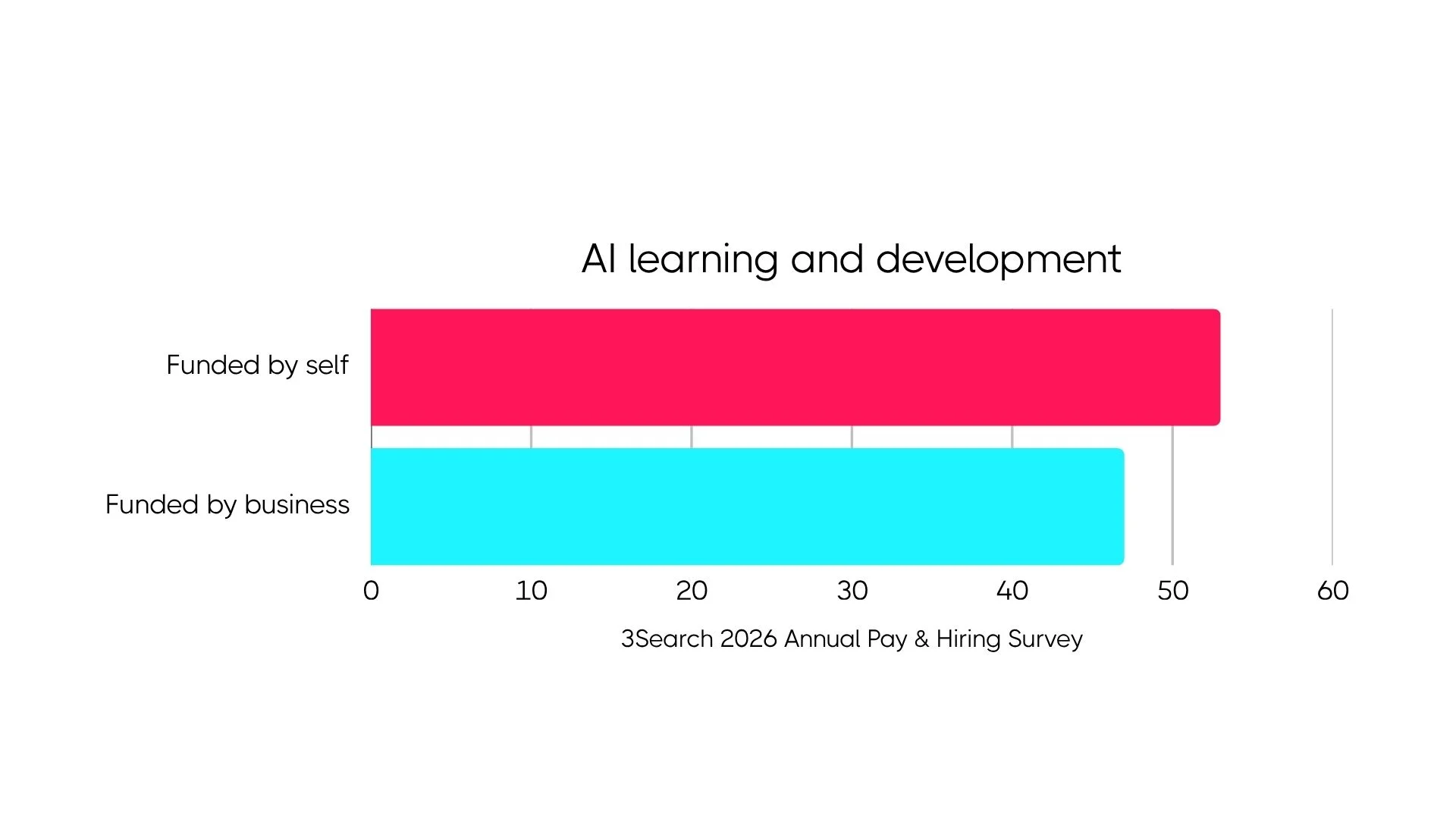
More than half of marketers (53%) say they are funding their own AI training, while fewer (47%) have that investment covered by their business. This is no surprise when nearly two-thirds (63%) of marketers believe that AI will have an impact on their careers. As such, AI marketing skills are critical for future proofing careers.
However, this is a notable shift from traditional learning and development models where upskilling is employer-led. While marketers are responding quickly to the rise of AI, many businesses have yet to formalise how they support AI training. This causes its own challenges, as a clear trend emerges around the seniority of those who are upskilling in the technology.
Junior marketers are being left behind
Over 80% of marketers say they are actively upskilling in AI, with fewer than one in five not currently doing so. This isn’t being driven by a single skill set. The data reflects a broad range of marketers across CRM, brand, digital, and generalist roles.
There is, however, a gap at the junior end of the market.
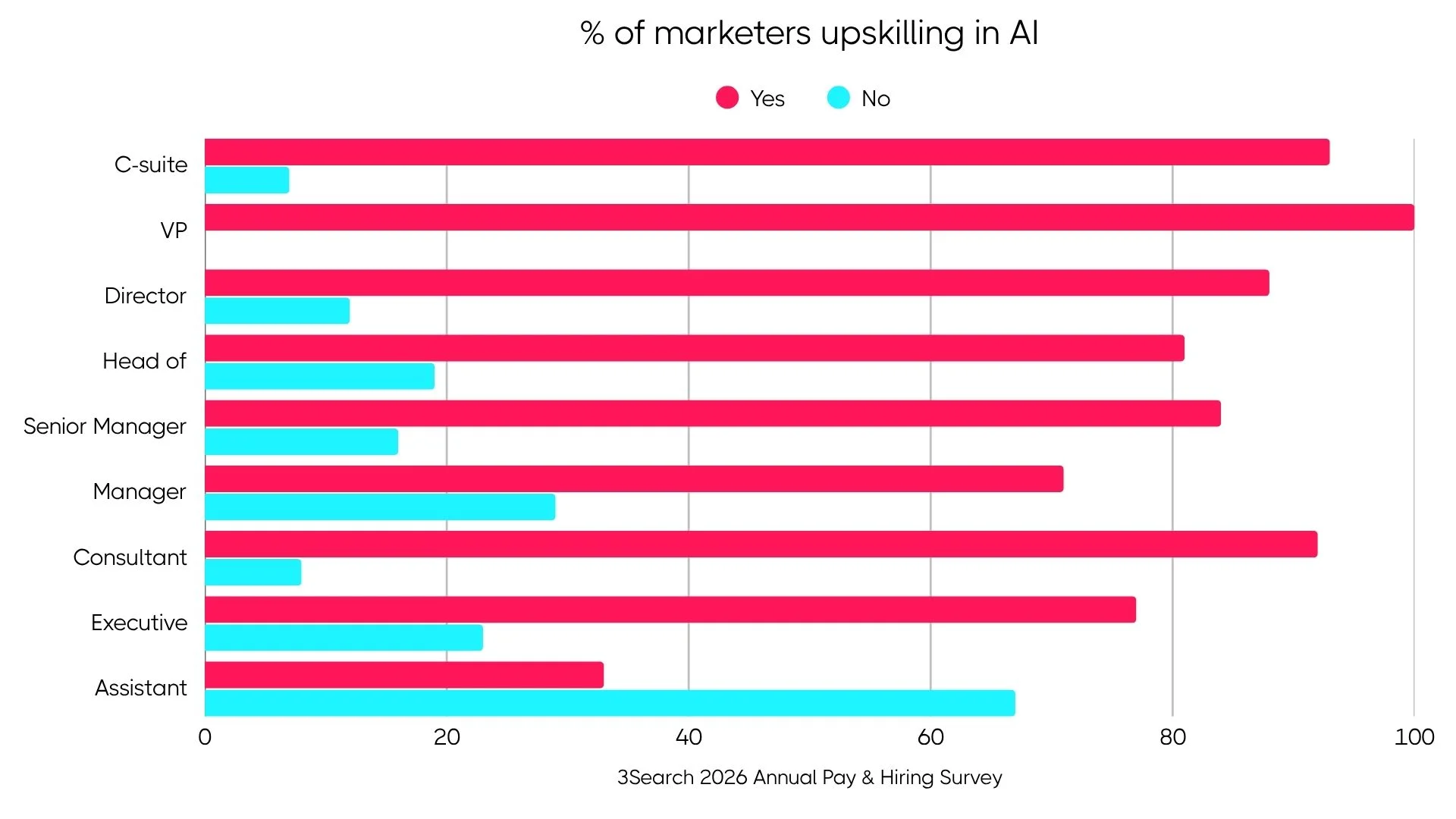
While 95% of marketers at C-suite or VP level are investing in AI training, just 74% of those at Executive or Assistant level are doing the same. This is a significant issue that we, as an industry, should be working to change.
As AI becomes increasingly integrated, there is a direct impact on the next generation of marketers that cannot be ignored. In fact, 37% of marketing leaders say that AI is already reducing the need for junior skills.
While we do not have all the answers, businesses must prioritise AI skills for new marketers.
Why should marketers build AI skills?
We’re seeing this shift as AI is beginning to have a tangible impact on marketing roles. The most immediate effect is productivity. Over three-quarters of marketers (77%) say AI is improving efficiency and output in their work.
AI is already changing marketing jobs
Our Co-founder, Charlie Rawstron, has 20 years of experience in marketing recruitment and a clear overview of how AI is impacting different areas of the commercial sector.
“Although we’re still in the early stages, we’re starting to move from something that is theoretical to something that’s being practically implemented within companies. Some obvious roles are ripe for automation, and certain businesses are now starting to implement AI agents that can automate some of those tasks and operate 24/7.”
Within marketing, that opportunity currently lies within performance marketing CRM, areas of design and low-level content creation.
At the same time, roles themselves are beginning to shift. Nearly half (49%) agree that AI has changed role requirements, although a significant proportion remains neutral. This suggests that while change is clearly underway, it isn’t yet fully defined or standardised across the market.
What is clear, however, is the emergence of new capability gaps. More than 70% of marketers say AI has created new training requirements. This means that marketers aren’t upskilling speculatively but responding to changes in how their roles are performed.
AI is creating structural change in marketing teams
There are also early signs of broader structural impact. Around half of respondents (51%) report cost savings linked to the introduction of AI, and a third (33%) say it is already reducing reliance on external suppliers or agencies.
Ultimately, this points to a shift in how marketing teams are structured and resourced.
How do marketers feel about AI?
The impact of so many operational changes is having an impact on how marketers view their careers.
- The need to adapt is widely recognised. 87% of marketers agree that AI will require them to learn new skills. This aligns directly with the high levels of upskilling already underway.
- The benefits are tangible. Over 80% say AI is already increasing their individual productivity. A majority (63%) expect their roles to become more strategic as a result, moving away from execution tasks and towards higher-value work.
- There is a strong sense of opportunity. Around two-thirds of marketers believe AI will create new opportunities within their sector.
- Optimism is balanced by a degree of uncertainty. 45% express concern about long-term job security, and only a small minority believe AI will have little impact on their career.
Overall, marketers view AI as inevitable and is actively trying to adapt.
Increased pressure on marketers
It is worth noting that two-thirds of marketers also reported workload growth over the past 12 months.
Workload growth between 2025-2026 is a trend reported by several industry bodies, many of whom attribute artificial intelligence as the cause of increasing pressure on employees. For example, ActivTrack’s analysis of almost 164,000 employees’ digital activity has revealed that “AI is adding to workloads rather than redistributing them [...] AI is being used as an additional productivity layer, not a substitute for existing work.”
Businesses should be mindful of this when developing AI training for marketers.
What do businesses need to know about AI in marketing?
Your teams are already engaging with AI, experimenting with tools, and building capability, whether formally supported or not. The risk is not a lack of adoption, but a lack of structure.
Without a coordinated approach to continuous learning and development, organisations may encounter:
- Inconsistent capability across teams
- Gaps between early adopters and the wider function
- Increased retention risk among high-performing, forward-thinking marketers
More broadly, there is competitive consideration. If AI is already improving productivity and reshaping roles, then the pace at which organisations enable that transformation will directly impact performance. This is especially true as the tools become more widely available.
Do you need support in developing your marketing team?
At 3Search, our team of specialist marketing recruiters are at the forefront of change in the industry. Working with hundreds of marketers and high-growth businesses, we know what works and what doesn’t.
If you need support in building your marketing team, do not hesitate to get in touch. Through our unique Advise, Attract, Develop methodology, we’ll help you identify top marketing talent and support their upskilling.