

The UK's conversation around salary transparency is moving closer to legislation. Last week, the government launched a consultation seeking views on proposed reforms of the UK's equal pay framework. Currently, ministers argue that the framework has become too complex, too slow and too reliant on individual workers pursuing lengthy legal claims. The aim is to shift the system from one that reacts to discrimination after it happens to one that prevents it.
This isn't unexpected and follows the introduction of Salary Transparency Laws in certain U.S. states and the EU Pay Transparency Directive.
In this article, we break down what the proposed changes could look like for employers.
What salary transparency is the UK government proposing?
Under the proposed reforms, employers may soon need to disclose salary information during the hiring process. As these changes are currently undergoing consultation, details are not confirmed. However, we can share the proposals and explain what they would mean for UK employers.
What could mandated salary transparency look like in the UK?
Although no one has confirmed anything yet, changes could require businesses to include compensation information in job ads. If you do not publicly advertise the role, you would be expected to share the details in writing before interviews. The changes would apply to businesses and third-parties, such as recruitment agencies and executive search firms.
Details around what must be included is still yet to be decided. The government intends "to ensure that the introduction of these requirements involves as little burden as possible for employers". To achieve this, they are deciding "what pay details or conditions, if any, should be included beyond basic salary." This might include:
- A clear list of benefits
- Potential bonuses
- Equity
- Commission information
We asked our network (from a job seeker and hiring manager perspective) what they would like to see from these changes. We reveal what they had to say below.
Why is the UK government proposing pay transparency?
The main aim of reforms is "to end pay discrimination" by making it less likely to occur in the first place.
Despite The Equality Act 2010 barring discrimination based on The Nine Protected Characteristics, pay disparities still occur. This can be accidental, where different teams work from historical pay practices and structures.
By requiring employers to advertise salaries, ministers believe that businesses will be more consistent with the compensation they offer. For instance, businesses might choose to create internal salary databases to ensure talent teams, business leaders and hiring managers are aligned on what different pay scales should look like.
However, there are many other benefits to sharing pay structures and scales during the recruitment process.
What should employers publish on job ads?
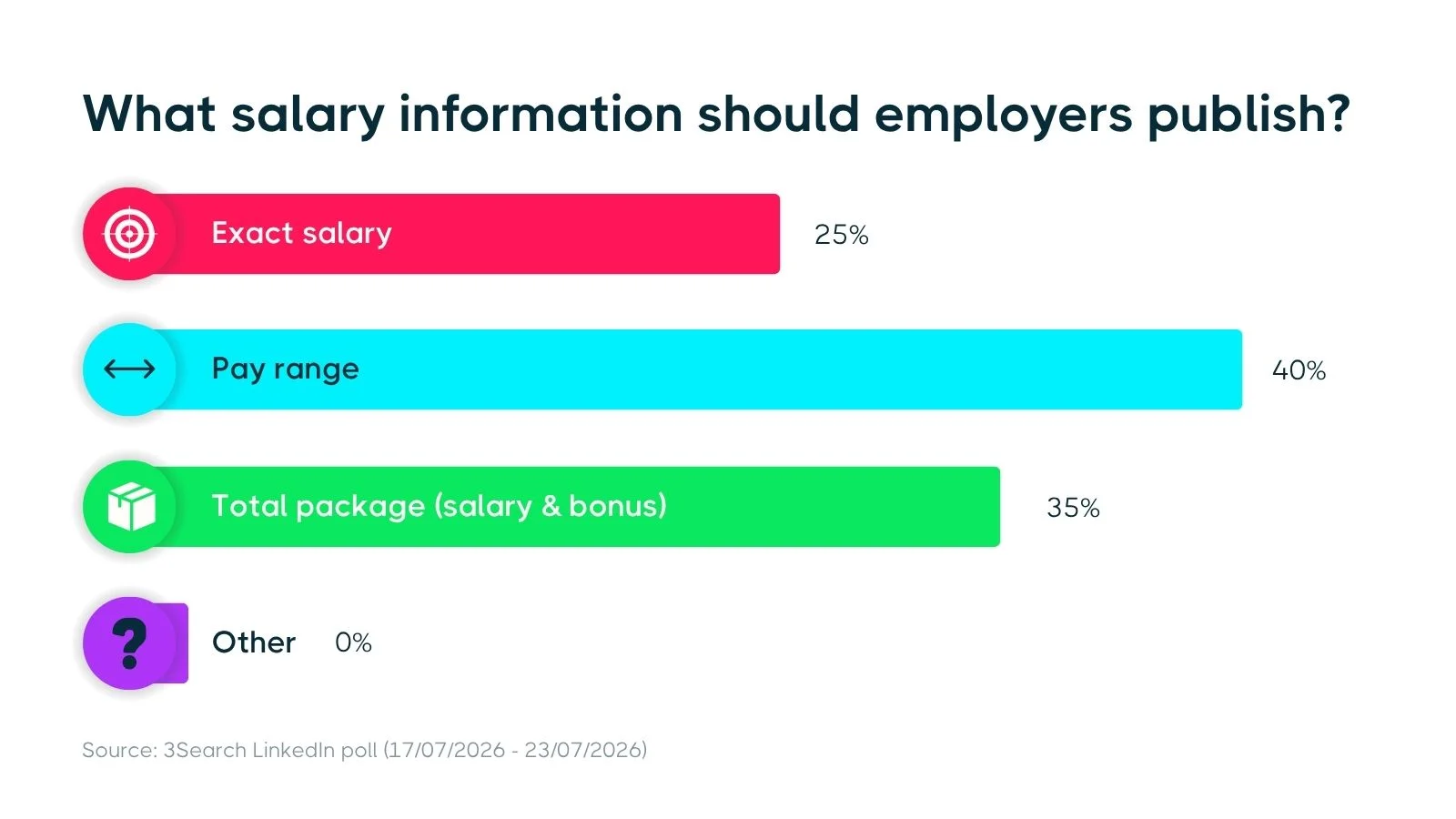
To explore market sentiment, we polled our LinkedIn network. We asked what information employers should provide if salary disclosure becomes mandatory. With nearly 650 votes, the results offer insight into how candidates, recruiters, hiring managers, and business leaders view salary transparency.
Why pay ranges came out on top
The strongest support was for salary bands rather than fixed figures, for example, "£45,000 - £55,000".
This isn't particularly surprising and is the most common option you currently see in the market. Salary ranges work well for candidates as they give enough information to determine whether a role is aligned with their expectations. Meanwhile, it still allows employers the flexibility to determine the final salary based on experience, capability, and potential of candidates they meet.
Two candidates applying for the same role may bring significantly different levels of experience, leadership capability, or sector expertise. A rigid fixed salary can create unnecessary constraints.
By providing clear ranges upfront, employers can improve candidate experience while reducing wasted effort on both sides.
Is an exact salary realistic?
One-quarter of respondents supported publishing the exact salary. We completely understand the appeal. An exact figure removes ambiguity and creates complete transparency. Candidates know exactly what is on offer before applying, while employers can demonstrate consistency and equality across their workforce.
However, many organisations would find this challenging in practice. Salaries are never based on job titles alone. Qualifications, experience, market conditions, geographic location, and skill scarcity can all influence final offers.
Publishing a fixed salary will reduce the talent pool for businesses, making it harder to attract exceptional talent who may justify compensation above the advertised amount. We have worked with a number of businesses who have adjusted the hiring budget during the recruitment process. This often happens once businesses have already met some candidates and built an understanding of the current talent market.

Equally, it could reduce flexibility when hiring less experienced candidates who may require development before reaching full productivity.
For this reason, while exact salaries may work well in some environments, particularly highly structured organisations or public sector roles, they may prove less practical across the broader private sector.
The growing importance of total compensation
Perhaps the most interesting finding was the strong support for publishing the total package, including bonuses and incentives. More than one-third of respondents selected this option, highlighting a shift in how professionals evaluate opportunities.
Salary remains important, but increasingly it is only one part of the decision-making process. In our 2026 Annual Pay & Hiring Report, it became clear that as salaries and flexible working policies are increasingly standardised, candidates are looking at other factors.
Many professionals now consider:
- Annual bonus potential
- Equity or share options
- Pension contributions
- Healthcare benefits
- Flexible working arrangements
- Additional leave and wellbeing benefits
A role with a £70,000 salary and a 20% bonus may be more attractive than one paying £75,000 with no extras. Providing visibility of the broader package helps candidates assess opportunities more accurately and allows employers to demonstrate the full value of their proposition.
What do other salary transparency laws look like?
The regulations in other countries can help paint a picture of what is coming for the UK. Plus, if you're looking to expand your business into a new country, you should be aware what is already in place in the EU and US.
Salary transparency in the EU
Implemented by EU member states on 7th June 2026, The EU Pay Transparency Directive aims to remove pay inequities by fostering a more open approach to compensation. While not applicable to the UK following Brexit, the rules do apply to UK companies with employees in EU member states.
If hiring in the EU, "Employers must disclose the starting salary or pay range for advertised positions in vacancy notices or ahead of interviews. They are also prohibited from asking candidates about their pay history." (pwc)
Companies must also:
- Report on their gender pay gap regularly (depending on company size)
- Comply to employees right to request average pay levels
- Communicate internally their strategy around compensation and progression
Salary transparency in North America
Pay transparency laws vary from state to state in North America. In 2026, 25 jurisdictions have a form of salary transparency regulations (Brightmine). Here is an overview of what this means:
- It is unlawful for businesses to post a job advertisement for a role based in the states or cities that have introduced the law without the salary.
- Typically, this means you need to include a minimum and maximum salary.
- Any role that will be performed in these areas, be it from an office or remotely, is covered by the law.
- The law is applicable to businesses and third parties, including employment agencies advertising a vacancy on behalf of an employer.
The rules do vary state by state and company size. As you begin your recruitment journey, you should be clear on the regulations that apply to you.
While our New York and Texas-based recruiters can advise you on the rules, we recommend maintaining salary transparency across every role as more states and cities continue to explore the benefits of pay transparency.
How should employers prepare for salary transparency in the UK?
Although UK-based roles do not require salary transparency yet, there is a clear path to new requirements. Organisations must take proactive steps to ensure they remain compliant. We recommend taking the following steps:
- Review existing job adverts
- Establish a structured salary framework
- Conduct regular market benchmarking
Review existing job adverts
Any vacancies published before pay transparency requirements came into force should be reviewed and updated. Providing this information upfront not only supports compliance, but also helps set expectations early in the hiring process, reducing the risk of misalignment later on.
Establish a structured salary framework
Historically, teams have had limited access to reliable salary data. This has made it difficult for employers to assess whether compensation was consistent across the business and competitive within the wider market.
With salary information now far more accessible, employees can compare their earnings against similar roles with ease. As a result, organisations need a clear and consistent approach to pay.
Developing a centralised salary framework for every role within the business can help create greater transparency and consistency. Regularly reviewing and refining these pay bands supports fair pay practices and keeps salaries competitive in a changing market.
Conduct regular market benchmarking
Compensation is influenced by a range of factors, including demand for skills, economic conditions and sector-specific trends. Salary expectations can shift quickly, particularly in competitive markets. Regular benchmarking allows employers to understand how their compensation packages compare and identify gaps before they impact retention or hiring.
Use 3Search's salary guides to start benchmarking your pay brackets or get in touch with our go-to-market recruiters for more personalised advice.
Specialist go-to-market recruitment in the UK, EU and US
As talent markets evolve across Europe and North America, our recruitment consultants are ready to advise your hiring journey. Get in touch to start working with us on your go-to-market hiring needs.