
There's sometimes a feeling among real estate marketers that on their AI journey, they're never far away from hitting a roadblock. There's even a fear that the sector can be an entire step behind other sectors. So, how is AI really affecting real estate marketing?
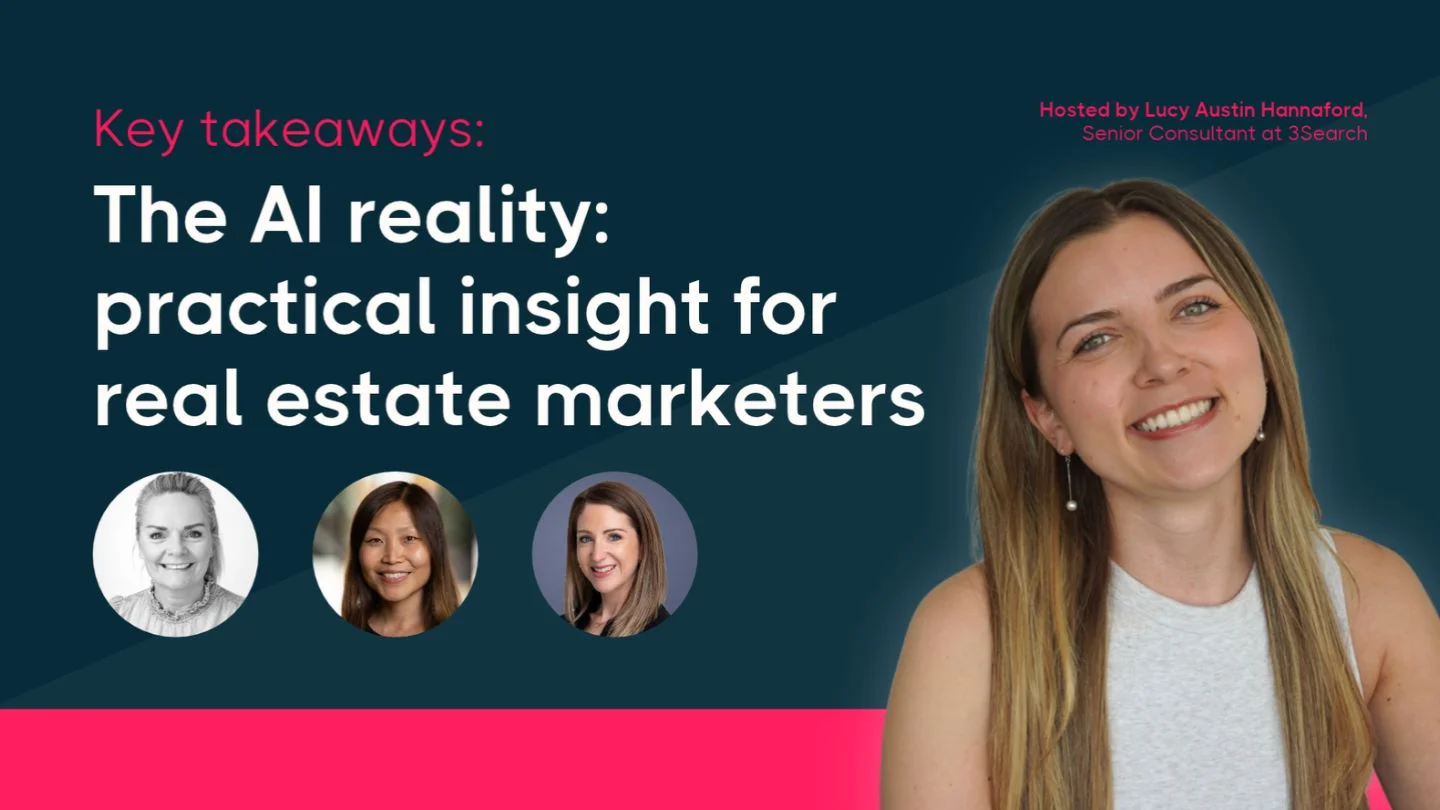
On Wednesday 7th October, Lucy Austin Hannaford from our real estate marketing recruitment team hosted a breakfast event exploring the reality of AI in property marketing teams. She was joined by:
- Fiona Sherwood, AI Trainer and Fractional CMO
- Cherry Tian, Head of Marketing at Workspace Group
- Natasha Woolfe, Head of Marketing Effectiveness at Knight Frank
Over 40 marketing professionals from our network joined us in our London office to break down some of the unknowns around AI. Together, we discussed the different AI tools marketing teams are adopting, how to upskill marketing teams now and in the long-term, and what the future looks like for AI in your team.
AI isn't a quick fix for broken systems
Are real estate businesses putting the foundations in place before adopting AI?
Natasha shared an interesting analogy that "too many organisations are using AI like peanut butter" – spreading it on top of broken or disconnected systems, like they're a piece of toast, in the hope that it will miraculously fix them.
Build your source of truth for AI systems
Natasha's advice was to build the foundations by baking in AI as a core ingredient, drawing a comparison with "peanut butter and banana muffins." Then you can "enhance your planning, enhance your strategic input, enhance the results and your optimisations. This way you're going to have much more success than trying to put a layer on top of something that's not really built for the process."
That means building one source of truth for strategy, delivery and reporting before asking AI to interpret any of it.
Bringing up the issue of security, Fiona warned that if your data isn't properly filed, labelled and secured, "you're potentially opening up all of your data to any Copilot search." Before switching anything on, you need to put the data layer in place, update your acceptable use policy and list of approved tools, and train everyone on what they can and can't put in.
Start with the problem you need to solve, not the tool you want to use
Before implementing any AI tools, you need to do is identify a business need. There was a feeling among our panel that too many marketers measure AI adoption by usage.
"The success of scaling AI is not really how much people are using AI in the business," said Cherry. "It's more how many problems you're really solving with your AI tools."
From a customer's perspective, looking at an item online doesn't always convey what it'll look like in real life. Cherry explained how Workspace Group uses AI-generated showroom images to help buyers picture the finished office and a floor plan tool to quickly turn architectural drawings into visually appealing floor plans. Both have had a measured commercial impact.
Check your outputs
AI can perform many tasks more accurately and more quickly than we can, but it won't always get everything right. Natasha described a campaign that appeared to have smashed its targets, but the AI had treated the mid-campaign results and final results as two separate datasets and double-counted a vast amount of the activity.
"It's amazing how confident AI is when it spits out the wrong information," she said. That's why it's always important to ask the AI to show its calculations and data sources before you publish any results.
"If you're not competent enough to check the output, you shouldn't be doing that task with it," said Fiona. This might particularly apply to junior staff who don't yet know what good looks like, which puts the onus on leaders educating their teams in AI best practices.
How to encourage AI adoption among marketing teams
While leadership is often keen to race ahead when it comes to AI adoption, the teams below them are often more anxious. Every time she goes into a training session with SMEs, Fiona finds that someone's worried about anything from their job to the future of humanity. Her approach is to address each concern directly and honestly, reassuring them that "just because it's there, you don't have to use it." She advises on proportionality: "Use it if it's a big chunky task, but don't use it if it's something you could turn out in 5 minutes."
What skills are important for AI adoption?
Cherry believes that mindset is more important than technical skills. Demonstrate what's possible, get people excited and make AI upskilling a personal development goal. As people tend to learn better from their peers, identifying "super users" early on, and using them as the ultimate advocates for AI in the business, can be a highly effective way of spreading their enthusiasm to the rest of the team.
Keep creativity to your people
There's a great deal of debate over how much we should involve AI in the creative process.
Fiona argued that excitement over content creation has reached a plateau, and that AI's rightful place is "the really boring admin back end process work that we all have to do."
She's also reported seeing a backlash against unlabelled AI-generated listings and images. The EU AI Act requires businesses to be transparent about AI-generated content, while the panel view labelling simply as good practice. Natasha's team now asks, in every briefing form, whether AI has been used.
How much autonomy should AI tools have?
There was a feeling that we should be cautious about how much autonomy we give to AI tools.
"Give AI as little decision-making power as possible," said Fiona, "So if you're building an agent, you need to be really prescriptive still about what you can do and what you can't do, so not giving it any free reign." The answer is to build agents with tight boundaries and let humans check the result.
What's coming next for AI in real estate marketing?
There are several new opportunities that AI presents real estate marketers:
- GEO (generative engine optimisation) is increasing in prominence all the time. Marketers aren't just reacting to AI search, but leveraging the tools to identify new opportunities. For example, our speakers shared how they're building agents to actively find content gaps, draft briefs and manage the review and approvals process.
- Insights agents that pull customer service data, interviews and sales feedback into one view are transforming the way real estate businesses manage their assets. When it comes to brand governance, AI is also helping them keep the brand consistent across building portfolios.
- KPI target generators are using previous campaign results to quickly set realistic and stretch targets.
How will AI change the marketing role?
Undoubtedly, the marketer's role will change significantly as AI becomes an increasingly important part of the day to day. Our panel expects the marketer of the future to focus less on campaign management and more on commercial and strategic leadership.
However, there was concern about how graduates will learn the foundations if AI is doing the bulk of basic tasks. It was suggested that AI is restricted during training, to allow entry-level marketers to build their own judgement.
Fiona suggested businesses document their processes so they don't become too reliant on the technology, "Don't outsource everything to AI; keep marketing to you."
Humanity is the differentiator in the AI world
AI has levelled the playing field in the real estate sector. With AI now widely used by real estate businesses, the smaller firms have the same tools as the big players in the market, so they can compete in a way they never have before. What will differentiate them is their human judgement, creativity, strategic development and the quality of their relationships.
Hire top property marketing talent to fuel your growth
3Search is a specialist marketing recruitment agency supporting scaling businesses with their talent needs. Our real estate recruitment team are building their expertise and networks to ensure you're best equipped to grow.
Through regular seminars and monthly breakfast discussions for senior leaders, we're building a community where marketing professionals in the real estate sector can share challenges, lessons and advice to help navigate the changing real estate landscape. If you'd like to join us at our next event, or you're a real estate marketing leader either looking for your next senior role or to build your marketing team, get in touch with our real estate marketing recruitment team.