With new technology reshaping the marketing profession, the role of a senior interim or fractional marketing leader has changed. You're still expected to land quickly and deliver measurable results in a short window, but now you're also expected to have a point of view on AI, show cost efficiency and hand over something that outlasts your contract.
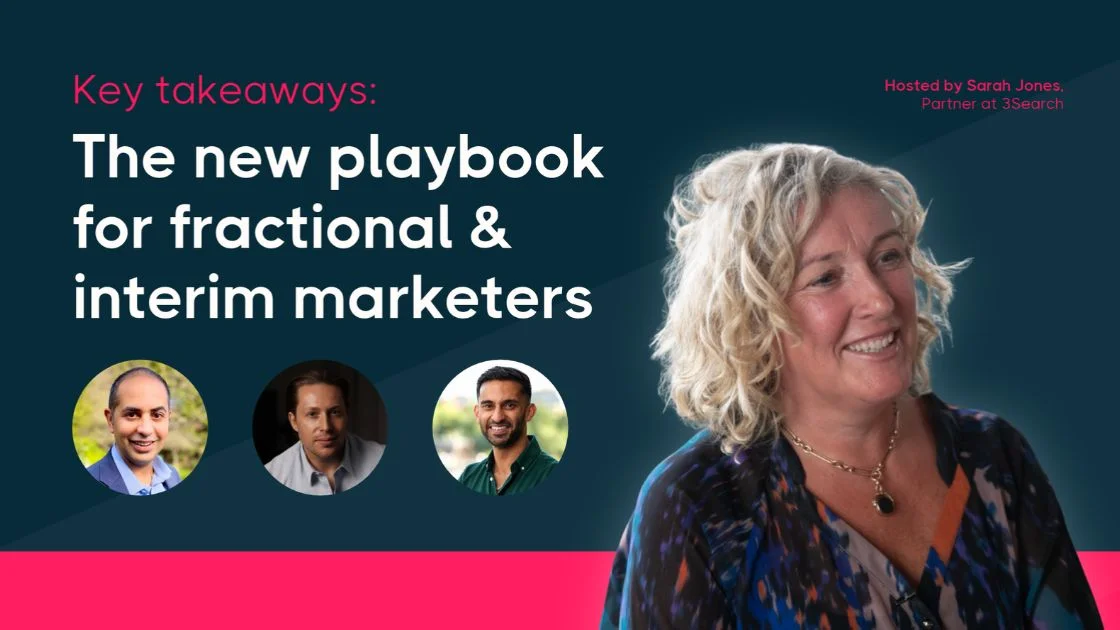
On Wednesday 11th November, Sarah Jones from our interim marketing recruitment team hosted an AI, growth and value creation breakfast seminar for interim and fractional professionals. She was joined by:
- Sumeet Vermani, Founder and CMO at SKV Consulting
- Tomas Seliokas, B2B SaaS CMO and Advisor
- Jay Safdar, Growth Marketing Lead at Lloyds Banking Group
Together, they discussed the growing role of fractional and interim marketing leadership, exploring how experienced leaders can combine their unique expertise with new technology to work more efficiently, accelerate delivery and increase their commercial impact.
The brief is bigger and the ideas are more polished
Tomas' first-week priority is to understand what the business means by success. Is it pipeline, annual recurring revenue (ARR) or market efficiency? And are the CEO and the board in agreement?
Requests from the board or CEO now tend to come with an added focus on AI implementation and cost efficiency. There's also been a notable increase in the quality of unsolicited ideas. Tomas has noted that the CEO's regular question about whether they can do something a competitor is doing, now "doesn't come as an email, it comes as a presentation deck."
Sumeet has also found that ideas are arriving as polished decks, logo designs and full marketing plans from people who don't necessarily know the business. His approach is to run those ideas back through AI and expose the gaps. As he put it, AI is "just telling you what you want to hear, and it's not actually finding the messy middle opportunity that allows you to stand out."
AI helps you diagnose, but people help you understand the business
All of our panellists use AI for analysis, competitor research and market scans – though none believe it can replace the first few weeks of conversations. Sumeet relies on the four Cs to get to know a business:
- Conversations
- Culture
- Connections
- Context
Businesses that bring in an interim are usually going through some kind of disruption, whether it's underperformance, a departed predecessor or rapid growth. Understanding that is a human job.
Jay suggested two practical ways to increase your understanding of the business:
- First, find out what's really motivating stakeholders, because it isn't always the headline KPI; his own CMO pushes to test new features first, partly to drive a cultural shift away from TV-led thinking.
- Second, find the source of truth for data and look for measurement gaps. Banking a couple of high-impact quick wins can help you build credibility while you do longer-term work in parallel.
Where to use AI and where not to
For Sumeet, the harder question is where not to use AI. He suggested using it heavily in the back office, based on solid data foundations and processes, but being careful about what you put out to the market. With AI-generated content flooding every channel, human experience is what will get you noticed. He also flagged liability as an area many leaders overlook: "You're not familiar about the legal liability that you personally have, because the legal ramifications of what we do with AI, and the data in the world, is still somewhat murky."
Working in a highly-regulated sector, Jay shared a cautionary tale about a team that generated 300 mortgage ads in four days, work that used to take months. It then took around three months to get them through approvals, because of unsuitable proof points and imagery that didn't fit the audience. The lesson was that AI makes the brief more important than ever, and the quality of the brief depends on real audience insight and understanding different motivators.
Focus on outcomes, not activity
Boards want to hear about results, what you learned and what you're changing as a result. "Presenting activity was always a mistake," said Tomas, when "talking to C-suite, or talking to board members." He now builds AI-driven efficiency into his plans, showing how a pipeline target needs less headcount, fewer agencies and less software than it used to. However, efficiency alone doesn't mean growth.
Jay found that introducing LTV:CAC at a FinTech – including headcount and operational costs, not just media cost-per-acquisition (CPA) – brought an uncomfortable first result, with the ratio close to break-even. However, it did give everyone a shared language, showed which channels and markets to back, and prompted some honest conversations about resourcing. Agile principles, such as two-week priorities and stand-ups, stop teams drifting into low value activity.
Build something that outlasts your contract
Jay focuses on building a legacy within a contract, asking "Are you leaving the business in a better place than you came into it?"
Tomas described a fractional CMO who encoded her frameworks into an AI tool whose purpose wasn't to generate ideas but to judge them. Long after she's left the role, the company still runs every campaign proposal, including the context, persona and ideal customer profile (ICP), using her criteria. His own handover test is to let go gradually and see whether the team can cope without him. If they can't, either his contract, or the handover period, needs to be extended.
There's a risk in being over-reliant on AI agents when you're the only person who understands how they work. Early on, make sure you put together clear, step-by-step instructions on how the agent is built, what data it uses and how to maintain it, so anyone can step in to manage it. Early engagement with IT, legal and procurement is also important. Knowledge siloes existed long before AI. Sumeet once saw a client's website go down after a predecessor left with no documentation, because a small renewal payment was tied to their personal credit card. AI adds "just another layer on top of that," he said. That's why it's important to build handover systems that keep working after you leave.
What will be expected of fractional and interim marketers leaders in the next few years?
How are expectations of senior marketing leaders shifting due to technological acceleration? The panel see four main ways in which the profession is changing:
- Seniority will become more hands-on: Leaders are increasingly expected to understand the platforms themselves, and even to build agents as part of the team. "Seniority doesn't necessarily mean someone else does everything for you," said Jay.
- Roles will widen: Demand is growing for people who are generalist and specialist at once. Jay had interviewed for a role combining acquisition, pricing and brand sponsorship. His advice is to learn the adjacent areas, such as CRM and product.
- Leaders will have to prove their value: Sumeet feels that every fractional marketing leader should be able to answer the question "Where is the value you're bringing that isn't AI?" Tomas answer was judgment; in particular, knowing when to say no and finding the real problem behind a plan. People will question the value "if all you can do is polish it," he warned.
- Marketers will need to rebuild trust in content: 94% of people in the UK have encountered misinformation on social media. As such, leaders must rebuild trust, understand watermarking rules and rethink strategies for a low-trust environment.
How to price yourself
If AI turns a month of strategising into a few days' work, what do you charge about your pricing? Tomas suggested pricing on outcomes rather than days, connecting your fee to the value you've delivered at similar companies. He cited a study of watch repairers which revealed that customers were happier when the repair took longer, even at the same price. People want to feel they've got more for their money.
However, the panel acknowledged that this is hard in practice. Day rates are what most businesses understand, so the cheapest bidder will often look the most attractive. Clients are paying for experience and proven delivery; a client that undervalues marketing will undervalue you whatever you charge. "I'm never going to be the cheapest person," said Sumeet. However, not everyone has the luxury of choosing, and sometimes you need to take the tactical job to get started.
Protecting data and ownership
The panel offered some practical guidance on using AI with client information:
- Where possible, use the client's own enterprise AI accounts, which sit within their governance framework.
- Agree early on who owns the inputs and the outputs, including any frameworks or tools you build, so you're protected later.
- Watch what marketing teams build. Tools built outside normal IT oversight, for example on public repositories, can accidentally expose customer data.
- Expect CIOs and CTOs to be more involved in procurement, concerned about data flowing in and out of tools.
- For martech AI founders selling into larger companies, be visible in AI search. Buyers increasingly ask AI for a shortlist so they can understand someone's fit, relying on peer networks and events for trust.
For more support in navigating a new interim market, get in touch
AI makes execution cheap. What will separate you is your understanding of the customer and your positioning as an organisation. As a leader, leave a blueprint behind so that the benefit of your work is felt long after you've left. While synthetic data and AI will help you get things done quickly, it needs to be paired with real human insight that helps you deliver the exceptional, not settle for the average.
Getting together with your marketing peers is a great way of increasing your understanding of the shifting nature of the role. If you'd like to attend our next event, are looking for your next fractional or interim marketing role, or want to strengthen your team, contact us now to discuss your requirements.