
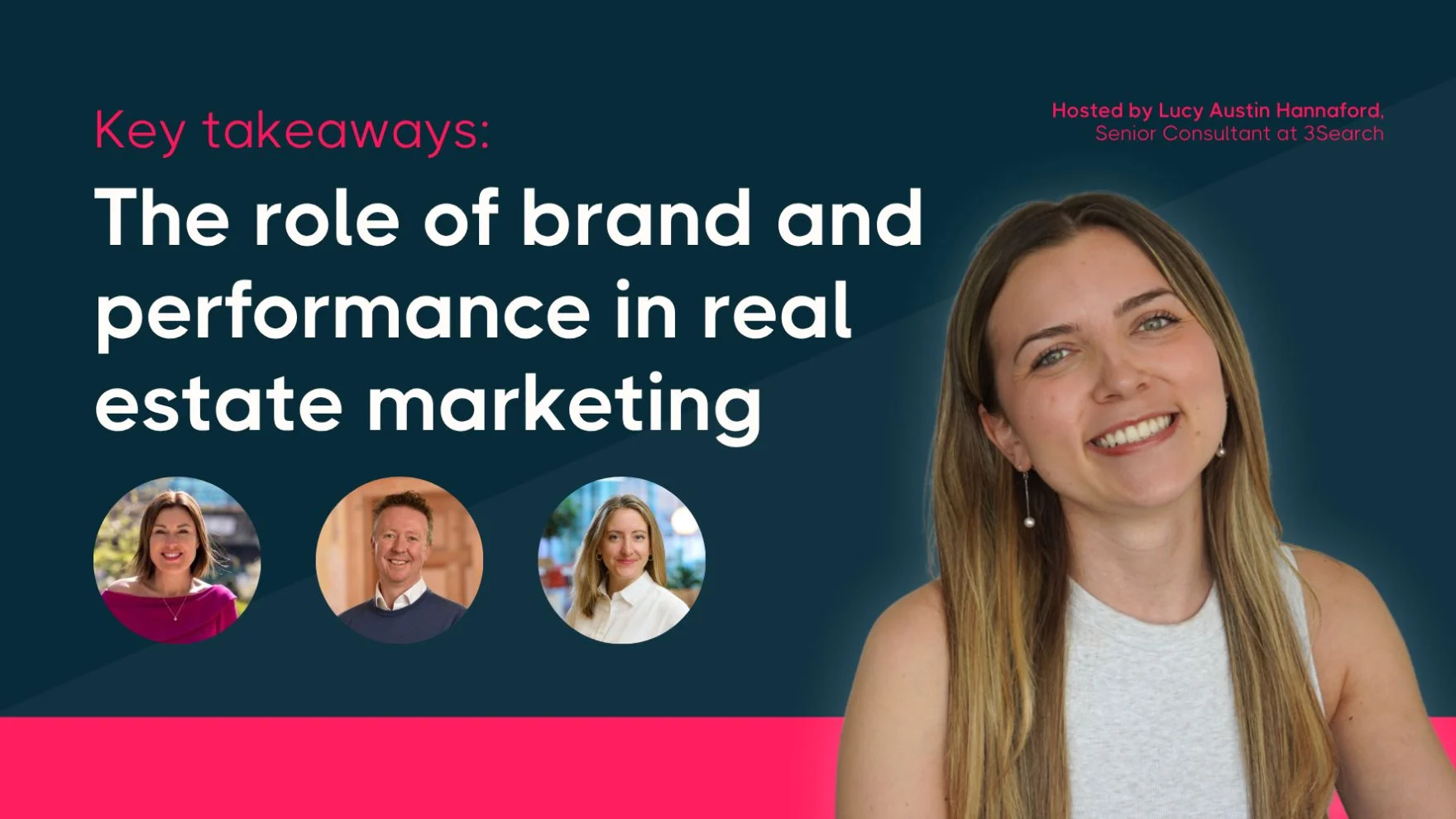
On Wednesday, 15th April 2026, specialist property recruiter, Lucy Austin Hannaford, brought together a panel of real estate marketing leaders to discuss a common shared challenge: How do you balance brand and performance in a market under pressure to deliver short-term results?
This article recounts the main discussion points from:
- Danielle Regan, Marketing Director at Mace
- Nick Andrews, former Head of Commercial Marketing at Knight Frank, now Marketing Director at Knotel
- Lucy Thomas, Marketing Director at Landsec
Key takeaways include:
- Brand and performance marketing should both play a role in your real estate marketing strategy. It's incredibly difficult to implement one successfully without investing in the other.
- As marketing has become more specialised, financial scrutiny has increased so the function must confidently justify commercial impact. This has led to an increased focus on short-term marketing goals.
- The most successful brands are building a marketing strategy that balances both performance and brand. They are outperforming those in their categories.
Keep reading for more.
Brand versus performance is a false trade-off
For years, brand and performance have been positioned as opposing priorities. Brand is a long-term strategy and difficult to measure, whilst performance is immediate and commercially accountable.
In reality, they are not separate strategies, but two parts of the same system.
Performance converts demand but brand creates it
Performance marketing is built to capture intent as strategies are designed to drive leads, convert traffic, and deliver measurable outcomes in the short term. As such, performance marketing is often prioritised, particularly in environments where marketing is under pressure to prove ROI. However, performance can only convert demand that already exists.
Brand is what creates that demand in the first place – building familiarity, trust and credibility long before a buyer enters the funnel. Ultimately, brand marketing shapes how a business is perceived in the market, often without the buyer even realising it.
Danielle Regan summarised, “They’re part of the same system. If you don’t invest in brand, performance becomes much harder and more expensive.”
Brand reduces friction across the funnel
One of the most important (and often overlooked) roles of brand is the way it improves performance outcomes. A strong brand does not just sit at the top of the funnel – it influences every stage of the buying journey.
When a brand is well established:
- Buyers are more likely to engage with marketing activity
- Sales conversations start from a position of trust
- Decision-making becomes faster and more confident
In sectors like real estate, where sales cycles are long and decisions carry significant risk, this becomes even more important. By the time a business is invited to pitch or tender, much of the decision has already been shaped by knowledge of the brand. The marketing has already done its job.
As Danielle said, “If we’re invited to tender, that’s the commercial value of marketing.”
The risk of short-term marketing goals
One of the most consistent themes from the discussion was the growing pressure on marketing to deliver immediate, measurable results.
Across industries, particularly in sectors like real estate, marketing is increasingly judged on what it can prove in the short term. Pipeline, leads, conversions and revenue attribution have become the dominant measures of success.
That shift hasn’t happened in isolation but driven by structural and cultural changes within organisations.
The shift to performance-first thinking
Over the past decade, marketing has become significantly more specialised. Where teams are now often broken down into highly focused disciplines (paid media, CRM, digital acquisition, SEO, automation), each are optimised for performance, with clear metrics and accountability.
At the same time, there has been a wider shift in how businesses make decisions. Financial scrutiny has increased, and with it, the need for marketing to justify its impact in commercial terms.
As Nick Andrews shared, “We’re not in the decade of the CMO… we’re in the decade of the CFO.”
This shift has naturally pulled marketing further down the funnel, towards activity that can be easily measured and directly linked to revenue.
The hidden cost of over-investing in performance
While this performance-first approach brings clarity and accountability, it also introduces risk.
When marketing is optimised purely for short-term outcomes, longer-term investment in brand is de-prioritised. Budgets are allocated to channels that deliver immediate returns, often at the expense of activity that builds future demand. Over time this creates a dependency on paid advertising.
We begin to see a cycle where:
- Brand visibility declines
- Differentiation becomes weaker
- Performance channels become less efficient
- Costs increase to maintain the same level of output
This is where the long-term impact is felt. What initially appears to be a more commercial approach to marketing can erode growth over time, as the business loses its ability to generate demand organically.
Nick reminded us of the 60:40 rule for balancing marketing spend, dedicating 60% for brand and 40% on performance.
Balance is a competitive edge
The businesses that are outperforming their competitors are those that recognise the limitations of short-termism and are actively working to rebalance their approach.
They clearly understand the role that both performance and brand building plays in a successful marketing strategy and they recognise that underinvesting in brand today will make performance harder tomorrow.
So, how do you do the same?
Brand is built on proof
Brand doesn’t behave the same way in real estate and property as it does in consumer markets. There are no impulse purchases - no one is making a decision based on a single campaign or a piece of creative. The stakes are too high, the timelines too long, and the decisions too complex.
Instead, brand is built through evidence.
It is shaped by what a business has delivered, who it has worked with, and how it shows up over time. Projects, partnerships and people become the strongest signals of credibility.
This shifts the role of marketing. Rather than trying to create demand through large-scale campaigns, the focus becomes amplifying what already exists.
That might mean:
- Showcasing completed projects as proof points
- Elevating internal experts through thought leadership
- Turning client outcomes into compelling case studies
- Using employees as brand ambassadors across events, media and social
In this context, marketing takes real-world delivery and ensures the market understands its value.
Consistency and clarity matter more than creativity alone
While creativity still plays an important role in brand building, our speakers highlighted that the most effective brands are not necessarily the most visually striking but the most consistent.
Strong brands are built through repetition, with clear market positioning reinforced over time, across every touchpoint.
That includes:
- How a business presents itself in a pitch
- The narrative it tells in a tender process
- The way it communicates in media and at events
- The experience it delivers on site
Every event contributes to how the brand is perceived. In industries with long buying cycles, these touchpoints accumulate to form a much bigger picture.
Marketing must speak the language of the board
To release budget for brand marketing and achieve that balance, marketing leaders must rethink how they position their function internally.
At board level, success is measured in revenue, profitability and efficiency. If marketing cannot clearly connect its activity to those outcomes, it risks being deprioritised in favour of more immediately tangible investments.
The most effective marketers are shifting the conversation, moving away from reporting on activity and instead demonstrating how marketing contributes to pipeline, supports commercial objectives and drives long-term growth. “It’s not about cost and budgets,” said Nick, “It’s about how we’re investing in growth.”
Lucy Thomas advised marketing leaders to constantly be educating what marketing can contribute throughout the business. Asking questions allows you to “find little ways that you can demonstrate how marketing has an impact on whatever that person’s interest is.”
Because ultimately, achieving the right balance between brand and performance isn’t a marketing decision, it’s a business one.
How effective is your real estate marketing strategy?
It's clear that to build an impactful marketing strategy in the real estate sector, you need the right combination of both performance and brand. If you need to invest in either skill set, be sure to reach out to our marketing recruiters who can help you identify the right talent for your organisation.
We want to extend a huge thank you to our speakers for sharing their time and insights with our attendees. If you’d like to join us at our next 3Search Event, keep an eye on our website and LinkedIn.