Few professions are as susceptible to current events as internal communications. Against a backdrop of global instability, economic uncertainty and technological acceleration, where does the profession stand as we approach the end of 2026? How does internal comms earn its strategic seat in an organisation and, more significantly, how does it keep it?
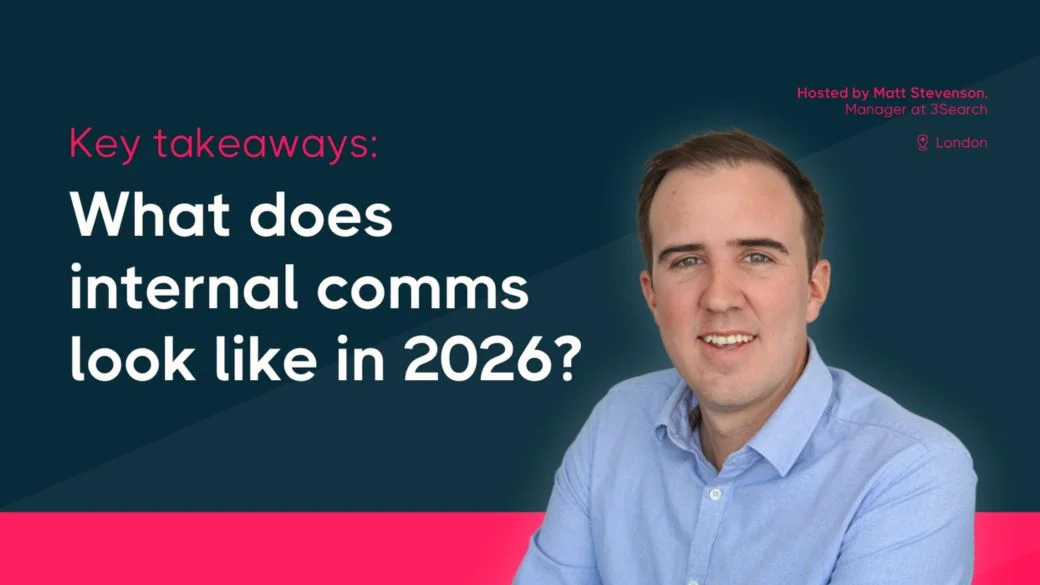
On Wednesday 28th October, Matthew Stevenson from our communications recruitment team hosted our annual roundtable exploring the current state of internal communications teams. He was joined by group internal comms leaders from industries including banking, tech, real estate, waste and recruitment, to discuss:
- How the function has developed in response to recent events
- How we can continue to elevate the profile of internal comms in the business now and in the future
- Employee engagement strategies and initiatives
- The current and long-term impact of AI on internal comms.
Your CEO shapes your internal comms function
There was a consensus that internal communications is only as influential as leadership allows.
Sometimes leaders don't entirely understand what the function does. There are CEOs who think internal comms doesn't extend any further than their profile or company newsletter. For the team to be successful, leaders need to get more involved in the process rather than sending out a single monthly message.
Where should internal communications teams sit in a company?
Reporting lines also have a significant impact on the effectiveness of internal comms in an organisation. Our attendees' functions have sat virtually anywhere in a business you can imagine, including:
- HR
- Marketing
- The CEO's office
- With a Chief of Staff
- A growth team
Sometimes, an apparently strange decision about where to locate an internal comms team can actually prove extremely effective. One leader had initially been resistant to reporting into HR, but now feels it was the right move for the business's current phase, and in the process learned how people teams can make finance-led decisions.
What is the purpose of internal comms teams?
Often, the purpose, aim and goals of communications teams can feel lost. How do you stop comms being blamed for outcomes it doesn't control? For example, when employee surveys say that communication is poor within the organisation, people are rarely complaining about the function.
"They're telling you that you're not talking to them. I can't solve that. I can create all of the moments to allow you to do that, but at the end of the day, the role of the leader is to lead."
There are a number of ways in which our attendees have changed the way they receive work to ensure their teams are only held accountable for delivering information and awareness, and not for the final operational outcomes.
- Some use briefs that ask for a separate project objective and communications objective, agreed together. Giving a safety example, one head of internal comms said that comms can't reduce work-related injuries, but it can make sure managers have people's emergency numbers in their phones. The key is not to make communication the reason something succeeds or fails.
- It also helps if briefs include a "why should I care?" field, which encourages the stakeholder to think about the purpose and importance of their communication, and a senior sponsor, ideally several levels below the executive committee, who can explain the reasoning behind it.
Comms needs to go beyond awareness so that people understand what you want them to do as a result of a communication. To help refine the message, the communications team should be a part of the discussion before a communication is finalised, so they can identify what will and won't land with employees, rather than inheriting a poorly tailored message.
Positioning internal comms as a strategic business partner
There's a perception that internal comms is all about yoga classes, coffee mornings and benefits reminders, but how do you change that?
When they inherited a team of eight (for an organisation of 3,500 people) and a calendar full of low-value activity, one leader found it most effective to tie work to strategic priorities or politely decline. Another asked intranet owners to look after their own home pages, spreading the workload.
There can be a fine line between internal comms, employee engagement and HR comms, often blurred by job descriptions. But in reality, two roles with the same title can be very different jobs. That's why it's useful to separate them with labels such as "internal corporate comms" for the senior leadership voice and "people comms" for the HR voice.
How can communications teams can scale?
Too many comms teams have a workload and an audience that far exceed their capabilities. One Head of Internal Communications leads a team of four for 15,000 UK employees, half of whom have no email address. Our panellists shared some practical structures to help small teams handle big demand:
- Business unit comms leads: Finding that the term "Business Partner" could be off-putting for stakeholders, one leader dropped it in favour of a network of part-time "BUCLs" (Business Unit Communication Leads), who can give her a quick answer from each exco and a trusted second opinion on odd requests.
- Self-serve with guardrails: Teams which have fast-moving news to cover get their own space on the intranet and license to be less polished, while anything going to the whole company is still reviewed and published centrally.
- Tone-of-voice and checklist bots: Custom AI assistants score each draft against an internal checklist, covering whether it hits the audience, explains its purpose and gives the next step.
- A focus on project management: Finding that the scale and speed of internal comms is often underestimated, especially by people arriving from external comms, one team lead has a "Chief Whip" who triages briefs and runs a dashboard of workload, sign-offs and deadlines.
How AI is reshaping internal comms
Although comms is usually a stakeholder in AI rather than the lead – which is invariably the tech team – communications professionals are still reshaping the work in a number of ways. Organisations are increasingly consolidating overlapping software and AI tools onto single platforms to reduce costs and operational friction. One attendee, who uses four different tools for four separate tasks, said that streamlining this software would feel like "losing somebody from your team."
A common concern is that AI is now doing a lot of the first drafts juniors used to learn on. However, there's also an angle that AI isn't replacing juniors – it's just being used badly. One attendee gave the example of a graduate handing over AI output without reading it back, while another business is already citing AI as the reason not to approve a hire they still need.
To gain an insight into their people's critical thinking, several attendees reported that they now ask candidates how they use AI, both at work and in their personal lives. One attendee's business is providing mandatory AI training for every employee, from office staff to refuse collectors.
However comms teams use AI, our panellists agreed that the human side of the profession remains as important as ever. As one attendee put it, "AI's got the knowledge, but it hasn't got the wisdom."
The role of the communications professional is changing
There was a feeling among our attendees that having a lot of cross-sector experience can actually count against you. "It seems more that others pigeonhole us rather than us pigeonholing ourselves," said one. Moving from external to internal comms is often easier than the reverse, and some hiring managers still demand 15 years of internal-only experience from potential hires.
But for many hiring managers, the skills required for the role have expanded, with critical thinking, curiosity and the ability to run the machine day-to-day now the most valuable skills for today's internal comms professional. One leader now looks to hire journalists who ask the right questions, and project managers who can manage workload and deadlines, rather than specifically writers or comms people.
For support with building your internal communications team, get in touch
No matter how the industry and the tools change in the coming years, human interaction is what endures in the internal comms profession. That's why it's important that comms leaders get together to discuss trends, challenges and lessons in an ever-changing business world. If you'd like to join us at our next roundtable, or you're a communications leader looking to strengthen your team, please get in touch with our team.